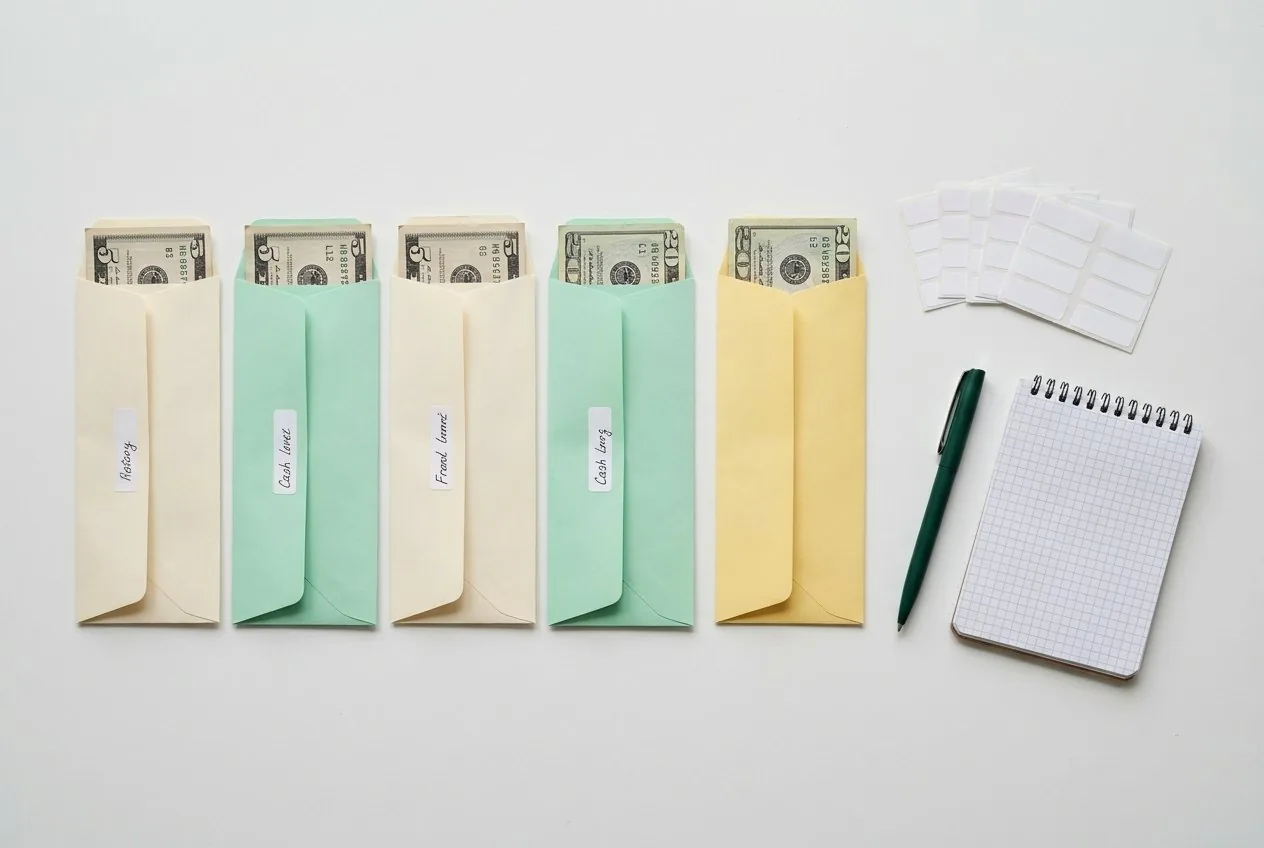
Your card taps in half a second, which is exactly the problem: $14 leaves your account and your brain never gets the memo. Then the statement arrives and the eating out category has somehow eaten $60 more than you planned, again. The cash envelope system puts the feeling back into spending, on purpose, and it’s the oldest overspending fix that still works.
The short answer: Pick your six to eight leakiest spending categories, withdraw each one’s monthly budget in cash on payday, and put the bills in labeled envelopes. You spend each category only from its envelope, and when an envelope is empty, that category is closed until next month. Fixed bills stay in the bank; only the flexible, overspend-prone categories go cash. That single rule, zero means zero, does the budget enforcement for you.
This guide covers the categories to start with, example amounts, a digital version for card-first households, and what to do when an envelope runs dry in week three. It’s a cornerstone of our budgeting basics pillar, and lately it’s back in fashion under a new name: cash stuffing.
Why cash works: the pain of paying, in plain English
Behavioral economists call it the pain of paying: handing over physical money registers as a small, real loss, while tapping a card registers less (Scientific Reports). Same $40, very different feeling. And paying keeps getting smoother, faster, and more invisible.
Envelopes reverse the trick. When you pay cash, three useful things happen:
- You feel the purchase while you can still change your mind, not three weeks later on a statement.
- The envelope shows your remaining balance at a glance. A thin envelope on the 18th is live feedback no app notification can match.
- Overspending becomes physically impossible. You can’t hand a cashier money that isn’t in the envelope. The system says no, so you don’t have to.
None of this is about punishing yourself. It’s about moving the moment of truth from the end of the month, when it’s too late, to the checkout line, when it’s not.
Step 1: Pick your first six to eight cash categories
Don’t convert your whole budget to cash. Fixed bills like rent, utilities, and insurance behave themselves on autopay; rent has never once overspent itself. Cash is for the flexible, swipe-happy, in-person categories where the leaks happen.
Here’s a starter set with example amounts. These numbers are an illustration for a family-sized budget, not a prescription; yours come from your own spending history.
| Envelope | Example monthly amount |
|---|---|
| Groceries | $500 |
| Eating out | $120 |
| Fun money, you | $80 |
| Fun money, partner | $80 |
| Kids + school stuff | $60 |
| Personal care | $50 |
| Household + cleaning | $60 |
| Gifts | $40 |
| Total cash | $990 |
A few casting notes:
- Groceries first. It’s the biggest flexible category in most budgets and the one where cash changes behavior fastest.
- Separate fun money envelopes if you share finances. His-and-hers envelopes prevent the world’s most repetitive argument.
- Gas can stay on the card. Paying inside with cash is an option, but pay-at-pump convenience wins for most people, and gas isn’t usually an impulse category.
Start with six. You can always add an envelope next month; a system you can run beats a system you can admire.
Step 2: Set the amounts from your real numbers
Envelope amounts aren’t guesses, they’re budget lines. Pull your last two months of statements, average each category, and round to an ATM-friendly number. If groceries averaged $487, the envelope gets $500 to start, and you can walk it down $20 at a time as your skills sharpen. Our grocery playbook, how to save money on groceries, pairs perfectly with a grocery envelope, because the envelope caps the spending while the tactics lower it.
If you don’t have a working budget yet, build that first; envelopes enforce a budget, they can’t replace one. The full walkthrough is here: how to make a budget for beginners.
Step 3: Build a payday stuffing routine
The system lives or dies on a ten-minute ritual:
- One withdrawal per payday. Take out the full envelope total in a single ATM or teller visit. Ask a teller for useful denominations: twenties for the big envelopes, plus fives and ones for small ones like gifts.
- Stuff and label. Each envelope gets its name and its monthly amount written on the front. Filling them takes two minutes and is weirdly satisfying, which is half the reason cash stuffing videos exist.
- Paid biweekly? Split the stuffing. Fund half of each envelope from each paycheck: the $500 grocery envelope gets $250 per payday. This also matches how you actually shop.
Consistency note: same day, same routine, every payday. The ritual is the system.
Step 4: Spend from the envelope, and let zero mean zero
At the store, the grocery envelope pays for groceries, and the receipt goes back in the envelope so the paper trail rides along. Some people jot a running balance on the envelope’s front, which turns it into a tiny, satisfying ledger.
Then the one rule that makes everything work: when an envelope is empty, that category is done until next month. No topping up from the card, no “just this once.” Zero means zero. It sounds strict, but it’s the strictness you signed up for, and it replaces a month of willpower with one decision made on payday.
Envelopes only work when the amounts inside them are honest, and honest amounts are a worksheet job: the templates in our free budget guide help you land on the right number for every envelope before you ever visit the ATM, so grab our free budget guide and set your amounts with math instead of vibes.
The hybrid version: digital envelopes for card-first households
Maybe your grocery order arrives in an app, your gas is pay-at-pump, and the idea of carrying $990 makes you itchy. Fair. You can keep most of the pain-of-paying benefit with a hybrid setup. Three versions, from most cash to least:
1. Cash for the leaks, cards for the rest. Run physical envelopes only for your two or three leakiest categories, usually groceries, eating out, and fun money, and leave everything else digital. This is the best-of-both starting point for most households.
2. The dedicated spending account. Open a second checking account with its own debit card. Each payday, transfer exactly your envelope total into it, and all flexible spending comes off that card. When the account runs low, the “envelope” is nearly empty, and the main account stays untouchable for spending.
3. Paper-tracked digital envelopes. Keep your normal card but track each category’s remaining balance on a printed sheet or a notes app, subtracting every purchase the day it happens. The pain of paying gets replaced by the pain of writing it down, which is milder but still real. This one takes the most discipline, so treat it as a graduate-level option.
The mechanism is the same in every version: a visible, shrinking balance per category, and a hard stop at zero.
A quick note on cash safety
Cash needs slightly different manners than a debit card, so a few house rules:
- Carry only today’s envelopes. Grocery run? The grocery envelope rides along and the other seven stay home.
- Store the rest somewhere boring. A locked box or an unremarkable spot at home beats the kitchen counter. Skip the obvious sock drawer.
- Envelopes hold spending money, not savings. This system is for one month of flexible cash. Your emergency fund and savings belong in a bank account, where they’re insured (FDIC) and earn interest.
- If losing the cash would sink your month, go hybrid. Version two above gives you the same guardrails with bank-level protection. That’s not cheating, it’s engineering.
When an envelope runs dry mid-month
It’s the 19th, the grocery envelope holds $6, and payday is ten days out. Week three, when envelope budgets usually meet reality. You have three moves, and the trick is picking one on purpose:
Move 1: Close the category. For fun money or eating out, empty simply means done until next month, and living that consequence once teaches better pacing than any app. For groceries, “closed” looks like a pantry week: cook down what the freezer and cupboard already hold. It’s rarely as grim as it sounds, and our grocery savings guide has stretch-the-pantry tactics for exactly this week.
Move 2: Make a public transfer. Sometimes groceries genuinely need a rescue. Fine: move $20 from fun money to groceries, and write the transfer on both envelopes. Funding one envelope from another in daylight is a budget decision; quietly topping up from the card is how the system rots.
Move 3: Fix the number. If the same envelope dies three months running, it isn’t a willpower problem, it’s a math problem. The envelope isn’t lying; the budget line was too small. Raise it, trim a calmer category to cover the difference, and let the system fit your real life instead of an aspirational one.
First-month wobbles are normal. The system tends to settle once the amounts and your habits have met in the middle.
FAQ
What about online shopping and bills?
Bills stay on autopay from your bank account; the envelope system never touches them. For online spending in a cash category, like a grocery pickup order, use the hybrid trick: pay by card, then move that amount of cash out of the envelope into a “spent online” envelope you redeposit at the bank later. The envelope still shrinks, so the feedback still works.
How much cash should I withdraw each month?
Exactly the total of your envelope amounts, no more. In the example table above that’s $990 a month, or $495 per biweekly paycheck. Everything else in your budget, bills, savings, and buffer, stays in the bank. If the withdrawal number makes you nervous, start with just a grocery and fun money envelope and grow from there.
What do I do with money left in an envelope at the end of the month?
Celebrate quietly, then choose: roll it over to give next month some slack, sweep it into savings, or stash it toward a sinking fund like holiday gifts. Leftover envelope cash is proof the number was right and the habit is working. Just don’t let it silently absorb into wallet money, because unassigned cash disappears exactly like unassigned dollars in checking.
Print your labels, pick your six categories, and let the envelopes do the discipline: grab our free budget guide and build your first cash budget tonight.
For your first system, a ready-made set like the Sooez cash envelope kit or an A6 zipper budget binder saves you from cutting up file folders: zippered cash envelopes plus expense sheets or labels, depending on the set, and you’re started tonight.
Sources & references
Before you go
The Already-Done Budget: Pre-Filled Starting Numbers for a Real Household Budget
A budget that starts filled in: 13 categories with realistic starting percentages from the 50/30/20 rule, pre-computed dollar amounts by income, and a worksheet to swap in your real numbers.
Free guide
The Already-Done Budget: Pre-Filled Starting Numbers for a Real Household Budget
A budget that starts filled in: 13 categories with realistic starting percentages from the 50/30/20 rule, pre-computed dollar amounts by income, and a worksheet to swap in your real numbers.