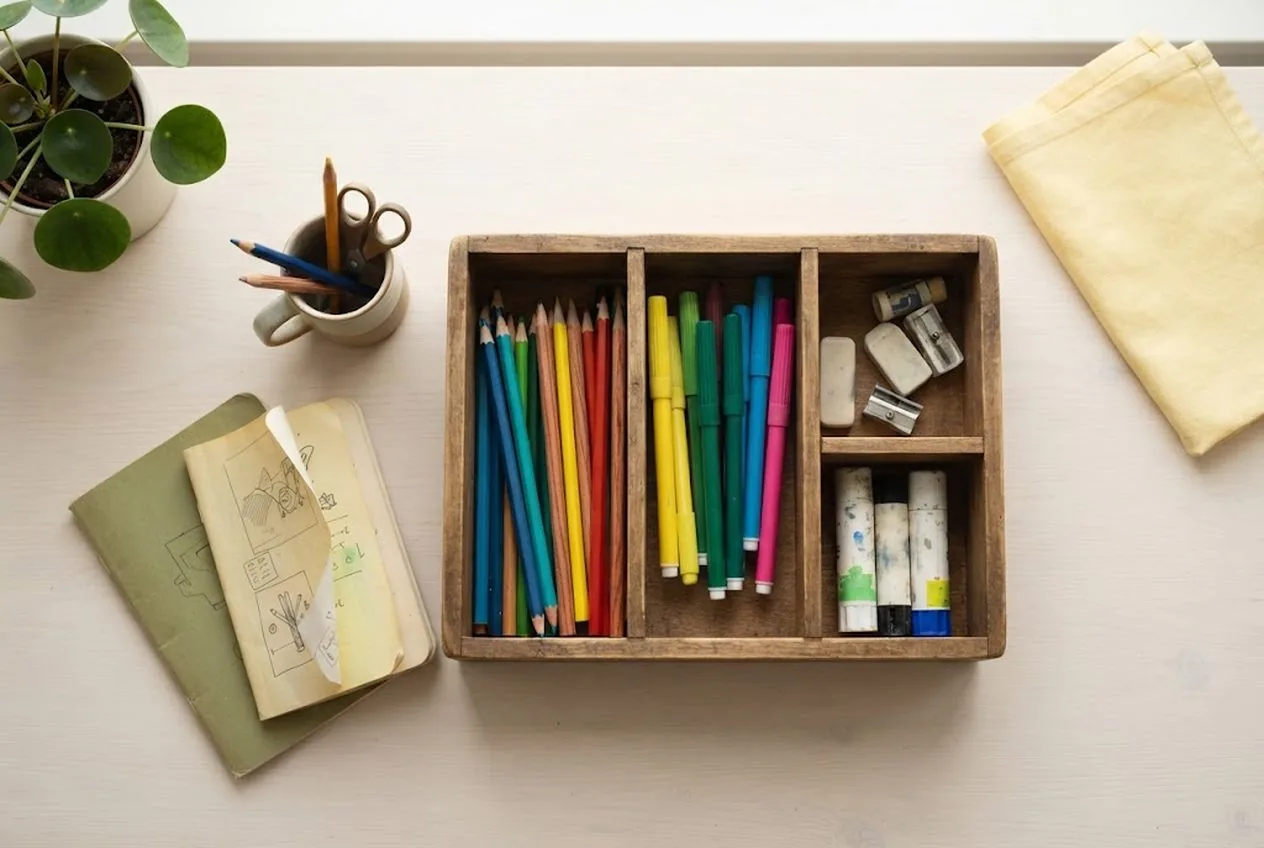
The cheapest school supply is the one already sitting in your junk drawer. Before you drive to a single store or fill a single online cart, there’s a free step that quietly knocks a big chunk off your back-to-school list: shop your own house first (EPA). Most homes are holding a small fortune in pencils, half-used notebooks, and last year’s perfectly good backpack. Here’s how to find it, count it, and only then buy what’s actually missing.
The short answer: do a fifteen-minute sweep of every drawer, backpack, and cabinet, gather what you find into one box, and check it against your school’s official supply list. Cross off everything you already own, refill from any bulk packs you bought earlier, reuse gear that still works, and write your final shopping list from just the gaps that are left. You’ll spend only on what your house genuinely couldn’t supply.
This guide lives in our budgeting basics library, and it runs on one idea: you can’t set a real school-supply budget until you know what you already own. Let’s find out.
Step 1: Do a whole-house supply sweep
Set a fifteen-minute timer and go hunting. Supplies scatter, so check every place they hide: the junk drawer, the bottoms of old backpacks, the craft bin, the home-office desk, the car, and that one chaotic cabinet everyone has. Pull everything school-related forward and gather it into a single box or laundry basket. Don’t sort or judge yet; just collect.
You’re looking for the obvious (pencils, pens, markers, crayons, glue, scissors, rulers) and the easy-to-forget (folders, index cards, highlighters, notebooks with plenty of blank pages left). Most families are genuinely surprised by the pile. That pile is money you already spent, and this is where you get to spend it again.
Step 2: Check your finds against the official list
Now the sweep becomes savings. Pull up your school’s official required list (most post it online by mid-summer) and lay your gathered supplies right next to it. Go line by line and cross off every item you already own in usable condition.
Be honest but not wasteful in both directions. A notebook that’s half full of last year’s spelling words still has plenty of blank pages, so it counts unless the teacher specifically requires a fresh one. A dried-out glue stick does not count. It’s common to knock a real chunk off a list at this step alone, and you haven’t spent a dime or clipped a single coupon.
Step 3: Refill from bulk you already bought
If you buy consumables in bulk (and it’s one of the cheapest habits there is), this is where past-you saves present-you money. Break open the big multipack of pencils, the value box of glue sticks, the ream of printer paper, the bulk pack of tissues. Kids burn through these every year, so a warehouse-size pack bought once can cover more than one back-to-school season.
Portion out what each kid’s list requires from those bulk stashes before you add a single consumable to your shopping list. Buying another 24-pack of pencils when 60 sit in the closet is exactly the kind of quiet leak a supply sweep is designed to catch.
Step 4: Repurpose last year’s gear
The big-ticket items are where “shop your house” saves the most, because a backpack costs many times what a pack of pencils does. Before you replace anything, ask whether last year’s version still works. A backpack that zips and isn’t torn, a lunchbox that cleans up, a binder with life left in it, a pencil case that’s fine, all do the same job as a new one.
Wipe them down, run the lunchbox through the dishwasher, and set them aside as “done.” The urge to buy new gear every August is usually marketing and comparison, not a school requirement. Save the replacements for what’s genuinely worn out or outgrown, and let your kid choose one or two small new things they actually want. That protects both the budget and the excitement.
Ready to lock in what you found? Grab our free budget guide, and jot your real back-to-school number in it now that the pile has shrunk it.
Step 5: Write a missing-only shopping list
Here’s the payoff. After the sweep, the crossing-off, the bulk refills, and the reuse, whatever’s still uncrossed on the official list is your entire shopping list. Write it out clean. It will be dramatically shorter than the list you started with, and every item on it is something your house genuinely couldn’t cover.
That short, specific list is also easier to shop cheaply. Instead of grabbing everything at full price in one panic trip, you can watch for a sale on those exact items, or time them to a back-to-school budget and any tax-free weekend. A small list is a flexible list.
What to do with the “extras” you find
A house sweep almost always turns up more than the list needs. Don’t let the surplus become clutter or, worse, an excuse to buy storage for it. Corral spare pencils, paper, and glue into one labeled “school supply” bin (EPA). When a kid loses a folder in October or a glue stick dries up in November, you shop the bin, not the store. That single bin quietly kills the mid-year restock runs that never make it into anyone’s budget (NRF).
The same habit works on groceries and pantry staples, by the way; the “shop what you own first” move is one of the highest-return money habits there is, and it’s the exact logic behind our grocery budget reset.
Make it a yearly ritual
Do this once and you’ll never buy blind again. Keep the supply bin stocked, do a fifteen-minute sweep the day the list drops, and back-to-school shopping shrinks to a short, cheap, specific errand instead of a full-cart scramble. Grab our free budget guide to hold your new smaller number, and browse the budgeting basics library for more free ways to spend less on the season.
What Not Rebuying Is Worth Over Time (Illustration, Not Advice)
Shopping your own house first before the school-supply run routinely saves a modest amount most families underestimate; call it $30 a month averaged across the year. Held at a flat, generic 4%/year rate, purely for arithmetic, that’s roughly $1,989 after five years on $1,800 actually set aside.
This is an illustration of opportunity cost, not advice: a flat, generic rate used for arithmetic only. It is not a forecast, and not a recommendation of any investment, product, platform, or timing. Your results will vary.
Frequently Asked Questions
- How much can you save by shopping your house for school supplies?
- It varies by household, but it's common to cross a good share of a supply list off before spending a cent, because most homes already own pencils, notebooks with blank pages, folders, and glue. The savings are biggest on consumables you buy in bulk and on reusable gear like backpacks and lunchboxes. Even a modest sweep usually pays for itself in the first ten minutes.
- What school supplies do most people already have at home?
- Pencils, pens, markers, crayons, glue sticks, scissors, rulers, folders, and notebooks with plenty of unused pages are the usual finds, along with last year's backpack, lunchbox, and pencil case in fine shape. Junk drawers, old backpacks, and craft bins are the top hiding spots. Gathering them into one box before you shop is what turns forgotten supplies into a smaller store list.
- Is it worth reusing last year's backpack and supplies?
- For anything still functional, absolutely. A backpack that zips and isn't ripped does the same job as a new one, and the pressure to replace it is usually marketing, not need. Reserve new purchases for genuinely worn-out or outgrown items, and let your kid pick one or two small new things they actually chose. That keeps both the budget and the excitement intact.
- When should I shop my house before back-to-school shopping?
- Do it as soon as the school posts its supply list, usually by mid-summer, and before you set foot in a store or click add-to-cart. Shopping your house first is what sets your real shopping list, so doing it early means you only buy the gaps and you have time to catch a sale on those specific items instead of grabbing everything at full price in one panic trip.
Sources & references
Before you go
The Already-Done Budget: Pre-Filled Starting Numbers for a Real Household Budget
A budget that starts filled in: 13 categories with realistic starting percentages from the 50/30/20 rule, pre-computed dollar amounts by income, and a worksheet to swap in your real numbers.
Free guide
The Already-Done Budget: Pre-Filled Starting Numbers for a Real Household Budget
A budget that starts filled in: 13 categories with realistic starting percentages from the 50/30/20 rule, pre-computed dollar amounts by income, and a worksheet to swap in your real numbers.