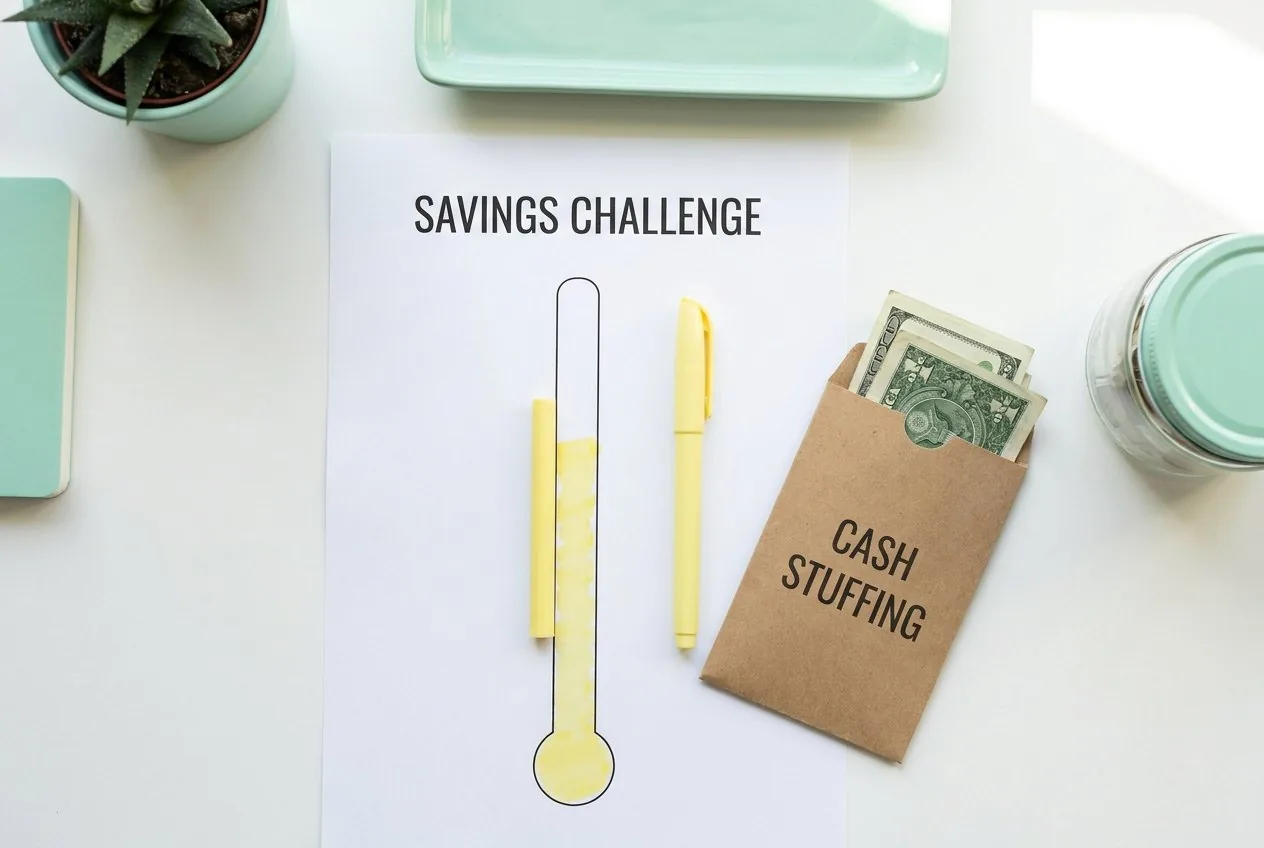
Five thousand dollars sounds like windfall money: a bonus, a tax refund, an inheritance from an aunt you forgot you had. It’s not. It’s 26 paydays with a plan attached. If you’re paid every two weeks, you already own the schedule; this challenge just gives each paycheck one small job.
The short answer: Set aside $193 from each of your 26 biweekly paychecks for a year. The deposits add up to $5,018 by the final payday, a little over the $5,000 goal on purpose. Track it on a printable chart, color in one block per deposit, and use the milestone rewards below to get through the boring middle. Tighter budget? The half version runs $96.50 per payday and comes out to $2,509.
The math: 26 paydays, $193 each
Most biweekly earners get 26 paychecks a year (IRS, Publication 15-T). Divide $5,000 by 26 and you get $192.31, which is a fussy number nobody wants to type into a transfer form. So round up to a clean $193 and check the total:
- 26 paydays x $193 = $5,018.
- That’s $18 past the goal. Consider it the tip.
Broken down further, $193 per paycheck is $96.50 a week, or about $13.79 a day. Not nothing, and we won’t pretend otherwise. But it’s one number, repeated 26 times, always on a day when money just arrived. That timing matters: saving on payday means the money leaves before it starts feeling like yours.
This is also why the biweekly frame beats a “save $5,000 this year” resolution. A year-sized goal has no obvious next step, so it politely waits until December to be a problem. A payday-sized goal has a next step every fourteen days, and each one is small enough to survive a normal life with normal surprises in it.
The laziest version, and honestly the strongest one, is automation: set a recurring $193 transfer from checking to savings (CFPB), scheduled for the morning after every payday. You decide once instead of 26 times, and the challenge quietly runs itself while you get on with your week.
The full payday-by-payday chart
Here’s all 26 deposits with running totals, so you always know exactly where you stand.
| Payday # | Deposit | Running Total |
|---|---|---|
| 1 | $193 | $193 |
| 2 | $193 | $386 |
| 3 | $193 | $579 |
| 4 | $193 | $772 |
| 5 | $193 | $965 |
| 6 | $193 | $1,158 |
| 7 | $193 | $1,351 |
| 8 | $193 | $1,544 |
| 9 | $193 | $1,737 |
| 10 | $193 | $1,930 |
| 11 | $193 | $2,123 |
| 12 | $193 | $2,316 |
| 13 | $193 | $2,509 |
| 14 | $193 | $2,702 |
| 15 | $193 | $2,895 |
| 16 | $193 | $3,088 |
| 17 | $193 | $3,281 |
| 18 | $193 | $3,474 |
| 19 | $193 | $3,667 |
| 20 | $193 | $3,860 |
| 21 | $193 | $4,053 |
| 22 | $193 | $4,246 |
| 23 | $193 | $4,439 |
| 24 | $193 | $4,632 |
| 25 | $193 | $4,825 |
| 26 | $193 | $5,018 |
If you’d rather color your way there than read a table, any blank weekly grid works fine to color in. Grab our free budget guide and put payday number one on paper.
Where the $193 comes from: 8 example cuts
The most common objection to this challenge is fair: “I don’t have a spare $193 lying around every two weeks.” Almost nobody does. The money gets assembled from smaller pieces. Here’s one worked example of eight cuts that add up to exactly $193 per two-week pay period. These are examples, not assignments; your list will look different, and that’s fine.
| Example cut (per 2 weeks) | Amount |
|---|---|
| Meal planning around the grocery ad instead of winging it | $40 |
| One takeout dinner becomes one pantry dinner | $35 |
| Coffee shop twice a week instead of five times | $28 |
| Streaming and app audit (drop two you forgot you pay for) | $25 |
| Generic swaps on pantry staples and cleaning supplies | $20 |
| Batching errands into one gas-saving trip | $18 |
| A 24-hour rule on impulse buys under $25 | $15 |
| Thermostat and laundry tweaks on the utility bill | $12 |
| Total per payday | $193 |
Notice that three of the eight rows live at the grocery store. That’s typical, because groceries are the most flexible big line in most budgets. If you want to go deeper on that lever, our guide to saving money on groceries breaks down where the slack usually hides.
Milestone rewards: how to survive the middle
Every long challenge has a dead zone. For this one it’s roughly paydays 8 through 18, when the novelty is gone and the finish line is still a season away. Nothing is wrong with you when the excitement fades; that’s just what months do. The fix is to pre-plan small rewards at set milestones, so your brain gets paid before December does. Write them on the tracker now, while you’re still enthusiastic, and they’ll be waiting when you’re not.
- Payday 6 ($1,158): you’ve crossed $1,000. Reward: something free but deliberate, like a library-book-and-bath night you actually schedule.
- Payday 13 ($2,509): halfway. Reward: a small treat under $20, paid from your regular budget, never from the challenge fund.
- Payday 20 ($3,860): the home stretch begins. Reward: plan how the $5,018 will be used, in writing. Naming the goal is weirdly motivating.
- Payday 26 ($5,018): done. Celebrate like someone who just did a hard thing over 52 weeks, because you did.
One rule: rewards never come out of the challenge money. The fund only moves in one direction.
The half version for tighter budgets
If $193 per paycheck reads like a joke in your current season, don’t sit the year out. Run the half challenge: $96.50 per payday x 26 paydays = $2,509. Same schedule, same tracker (color half a block, or every other block), half the pressure. Twenty-five hundred dollars is a real emergency cushion, and finishing a scaled-down challenge builds the exact same habit as finishing a full one.
And no, the smaller number doesn’t make you less serious about money. The person who finishes $2,509 learned more this year than the person who quit $5,018 in March. You can always run the full version next year with the muscle you built on this one.
What to do when you miss a payday
Somewhere around payday nine, something will break, expire, or need new shoes. That’s not a character flaw; it’s a Tuesday. When a deposit doesn’t happen, skip the guilt spiral and pick one of these three recoveries:
- Extend by one. Add a payday 27 to your calendar (or roll into the first paycheck of next year). Total still lands at $5,018, two weeks late. Nobody’s checking.
- Spread the gap. Split the missed $193 across the remaining paydays. Miss one with ten to go, and each remaining deposit becomes $212.30.
- Let it stand. Twenty-five deposits come out to $4,825. If that’s the year you had, $4,825 is a result worth being proud of, not a rounding error of failure.
The plan serves you, not the other way around.
Start on any payday
You don’t need a January 1st. The chart says “Payday 1,” not “the first Friday of the year.” Start with your next paycheck, whenever it lands, and payday 26 arrives one year later. Starting in July just means your finish line has fireworks.
FAQ
What if I’m paid weekly or monthly instead of biweekly?
Same goal, different slicing. Weekly: $96.50 x 52 weeks comes out to $5,018. Monthly: $418 x 12 months comes out to $5,016. Pick the version that matches the day money actually arrives, because payday-timed transfers are the ones that survive.
Is $193 per paycheck realistic?
For some budgets yes, for many no, and there’s no shame in either answer. That’s exactly why the half version ($96.50 per payday, $2,509 total) exists. Run whichever number your budget can repeat 26 times, because repetition is the whole engine.
Where should the money live?
A separate savings account with its own name works well: visible enough to feel proud of, separate enough that it doesn’t get spent by accident. If you’re doing a cash version, move it to the bank regularly rather than storing a growing pile at home (FDIC).
How does this compare to other savings challenges?
The 52-week money challenge is gentler ($1,378 total, averaging $26.50 a week) and great for first-timers. The 100 envelope challenge is steeper and randomized ($5,050 total). This one sits in between on difficulty but wins on autopilot-friendliness. Browse the full savings challenges pillar to match a challenge to your season.
Your next paycheck already has a date, so give it a job: print a simple 26-box grid, and grab our free budget guide to keep the rest of your money organized too.
If you’d rather stuff cash than watch a spreadsheet, an A6 budget binder with numbered pockets turns the same 26-deposit ladder into something you can see and touch.
Sources & references
Before you go
The Already-Done Budget: Pre-Filled Starting Numbers for a Real Household Budget
A budget that starts filled in: 13 categories with realistic starting percentages from the 50/30/20 rule, pre-computed dollar amounts by income, and a worksheet to swap in your real numbers.
Free guide
The Already-Done Budget: Pre-Filled Starting Numbers for a Real Household Budget
A budget that starts filled in: 13 categories with realistic starting percentages from the 50/30/20 rule, pre-computed dollar amounts by income, and a worksheet to swap in your real numbers.