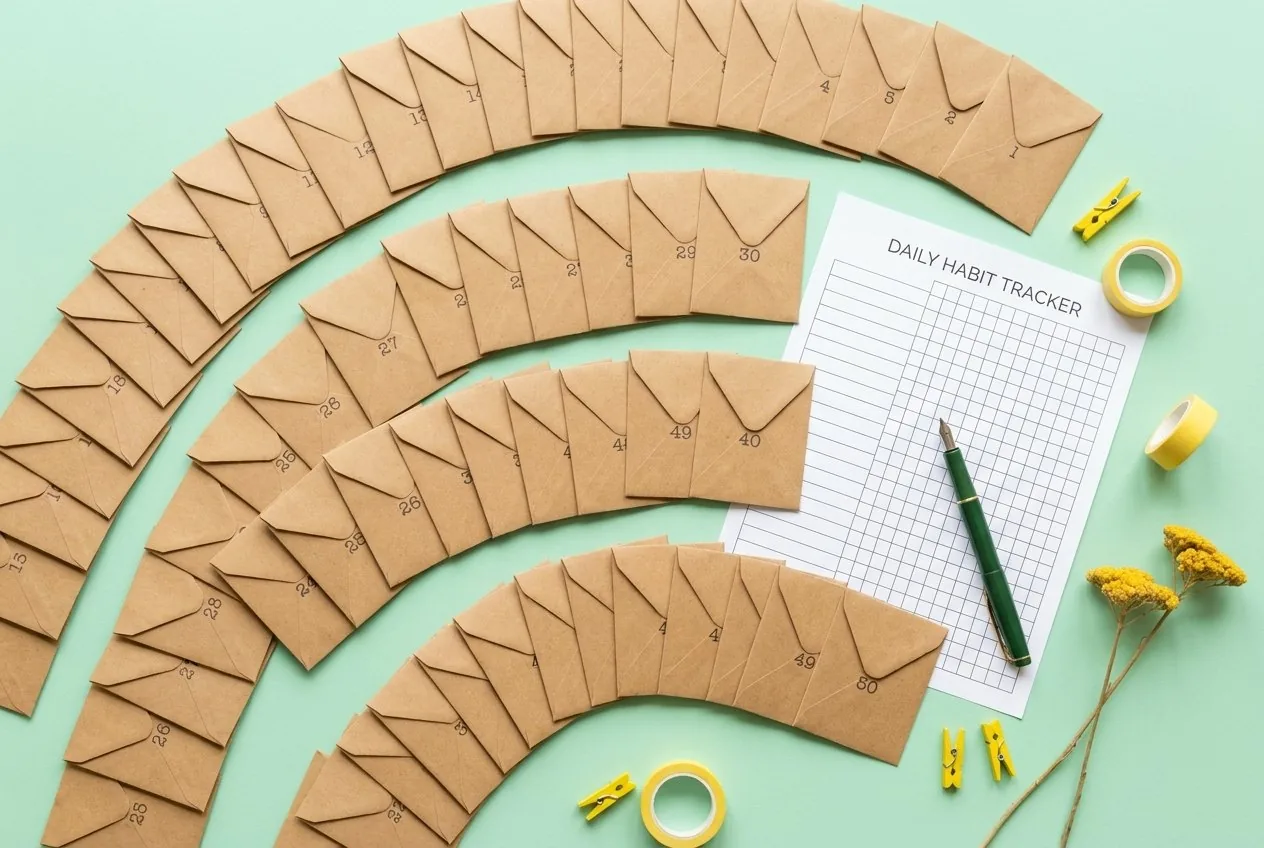
You’ve seen it on Pinterest and TikTok: a shoebox of numbered envelopes, a hand pulling one out like a raffle ticket, a caption about $5,050. The 100 envelope challenge is the most game-like savings method on the internet, and that’s exactly why it works for people who find regular saving boring. Here’s how it actually functions, what the math says, and the smarter ways to run it.
The short answer: Number 100 envelopes from 1 to 100, shuffle them, and draw one at random (one a day, or two a week). Whatever number you draw, you stuff that many dollars inside and set the envelope aside. Fill all 100 and the contents add up to exactly $5,050, which is arithmetic, not a promise. The random draw is the fun part and the risky part, so this guide includes an easier half version and a safer bank-transfer version.
What is the 100 envelope challenge?
It’s a savings challenge dressed up as a game of chance. The full rules:
- Get 100 envelopes and number them 1 through 100.
- Shuffle them into a box, basket, or bag so the order is random.
- On a schedule you pick (the classic is one envelope a day, or two a week for a slower pace), draw one envelope without peeking.
- Put that many dollars in cash inside. Draw envelope 42, stuff $42.
- Seal it, mark it off on a tracker, and put it in the “done” pile.
- When all 100 envelopes are stuffed, the challenge is complete.
No account minimums, no app, no spreadsheet required. Dollar-store envelopes and a marker will do; the challenge doesn’t get better because the supplies got cuter.
How does the $5,050 math work?
Add every number from 1 to 100. The shortcut: pair the smallest with the largest. 1 + 100 = 101. 2 + 99 = 101. There are 50 pairs like that, so 50 x 101 = $5,050.
Two more numbers worth knowing before you commit:
- The average envelope holds $50.50. Every draw is a coin flip around that number, so over time the challenge behaves like saving $50.50 per envelope.
- Pace sets the pressure. At two envelopes a week, that averages $101 a week. At one a day, it averages around $353.50 a week, which is a serious cash-flow commitment, not a cute one.
For honest comparison: the 52-week money challenge averages $26.50 a week. This challenge, at its gentlest common pace, is roughly four times steeper. Knowing that going in is the difference between choosing a challenge and being ambushed by one.
How fast can you finish? A pace guide
| Pace | Time to finish | Average per week |
|---|---|---|
| 1 envelope a day | 100 days (about 14 weeks) | about $353.50 |
| 4 envelopes a week | 25 weeks | $202 |
| 3 envelopes a week | 34 weeks | about $151.50 |
| 2 envelopes a week | 50 weeks | $101 |
Pick the row whose right-hand column doesn’t make you laugh nervously. There’s no prize for the 100-day version; the envelopes hold the same $5,050 at any speed.
Whichever pace you choose, put it on paper. Any blank grid or checklist works to track your draws. Grab our free budget guide to give your budget a home base too.
Why the random draw works on your brain
Here’s the quietly clever part. Most savings plans fail because they’re predictable, and predictable is boring. The envelope draw borrows a trick from slot machines and phone games called variable reward: when you don’t know what you’ll get, the anticipation itself becomes the fun.
In plain words: drawing envelope 7 feels like winning (a cheap week!), and drawing envelope 93 feels like a plot twist you get to survive. Either way, you felt something, and feelings are what keep habits alive long after motivation clocks out. Add the visible progress of a fattening “done” pile and a tracker filling in, and you’ve turned the dullest chore in personal finance into something you low-key look forward to.
The same psychology has a sharp edge, though: a bad-luck streak of big numbers in a tight month can wreck the whole thing. That’s what the easier versions below are for.
Easier versions that still finish
The half challenge: $2,525
Run everything exactly the same, but stuff half the number drawn. Envelope 42 gets $21, envelope 100 gets $50. The total halves to $2,525, and the worst possible week halves with it. Same game, same dopamine, half the exposure. This is the version we’d hand most people starting out.
The 100-day digital version
No cash, no envelopes: write the numbers 1 to 100 on a printed tracker or list, and each day (or each draw day) use a random number picker, then transfer that amount from checking to savings (CFPB) and cross the number off. Same math, same suspense, and the money earns its keep in an actual bank account. If you like the envelope ritual but live a card-first life, this is your lane, and it pairs naturally with a digital take on the cash envelope system for the spending side of your budget.
A word about $5,050 in cash at home
We’d be lousy friends if we skipped this: finishing the classic version means five thousand dollars in paper money sitting in a shoebox. That’s a theft risk, a fire risk, and a “toddler found the scissors” risk, and a standard homeowners policy covers only $200 of cash (Insurance Information Institute). Money in a shoebox also earns nothing while it sits.
The fix is simple. Keep the draw ritual if you love it, but empty the stuffed envelopes into your bank account every week or two (FDIC), and let the tracker (not the shoebox) show your progress. Or run the digital version from the start. The game is the draw, not the hoard.
What NOT to do
- Don’t stuff envelopes with money that’s already spoken for. Rent money in envelope 87 is not saving, it’s hiding. The challenge runs on genuinely spare dollars, which is why a working budget comes first.
- Don’t draw blind when you’re broke. In a tight week, it’s fine to draw from a “low stack” (envelopes 1 through 30, say). A controlled draw beats a skipped week.
- Don’t try to catch up with giant multi-draws. Pulling 96, 98, and 100 in one guilty evening is how challenges die. Behind is fine; broke is not.
- Don’t restart from zero after a missed week. Your stuffed envelopes don’t un-stuff themselves. Pick up where you left off.
- Don’t let the full pile live in your closet for months. See the cash-safety note above.
Missed a week? Here’s the fix
Missing draws is normal, especially once the novelty wears off. The envelope challenge is actually the most forgiving challenge to fall behind on, because nothing about it is tied to the calendar. Your options: extend the timeline (50 weeks becomes 53, so what), switch to the low stack until cash flow recovers, or downgrade to the half version mid-challenge and keep every envelope you’ve already filled. The only losing move is stopping.
Start any day you like
There’s no January rule here. One hundred envelopes started in March are done by summer at a daily pace, and a two-a-week start in July wraps up before next July. The box doesn’t know what month it is.
Where this challenge fits
If randomness keeps you engaged, this beats a fixed plan you’d abandon. If surprise $90 weeks sound stressful, the steady $5,000 savings challenge reaches nearly the same total in 26 predictable payday deposits, and the savings challenges library has gentler on-ramps too.
Before you number envelope one, grab our free budget guide so your draws, your budget, and your progress all live on one printed page.
A binder with 100 numbered pockets, like the Sooez 100 envelope binder, keeps every envelope in one place instead of loose in a drawer, so pulling the right number on the right day takes ten seconds instead of a search.
Frequently Asked Questions
- How much money is the 100 envelope challenge?
- Filling all 100 envelopes adds up to exactly $5,050. The half version, where you stuff half of each number drawn, comes out to $2,525. That is arithmetic, not a promise.
- How long does the 100 envelope challenge take?
- At the classic one-a-day pace, 100 days. At two envelopes a week, 50 weeks. Most people land somewhere in between, and the total is identical at any speed.
- Can I do the 100 envelope challenge without cash?
- Yes, and honestly we recommend it. Use a random number picker and a bank transfer instead of paper and cash. Same numbers, same fun, none of the shoebox risk.
- Is this better than a fixed savings challenge?
- It depends on your brain. If randomness keeps you engaged, this beats a fixed plan you would abandon. If surprise $90 weeks sound stressful, the steady $5,000 savings challenge reaches nearly the same total in 26 predictable payday deposits, and the savings challenges library has gentler on-ramps too.
Sources & references
Before you go
The Already-Done Budget: Pre-Filled Starting Numbers for a Real Household Budget
A budget that starts filled in: 13 categories with realistic starting percentages from the 50/30/20 rule, pre-computed dollar amounts by income, and a worksheet to swap in your real numbers.
Free guide
The Already-Done Budget: Pre-Filled Starting Numbers for a Real Household Budget
A budget that starts filled in: 13 categories with realistic starting percentages from the 50/30/20 rule, pre-computed dollar amounts by income, and a worksheet to swap in your real numbers.