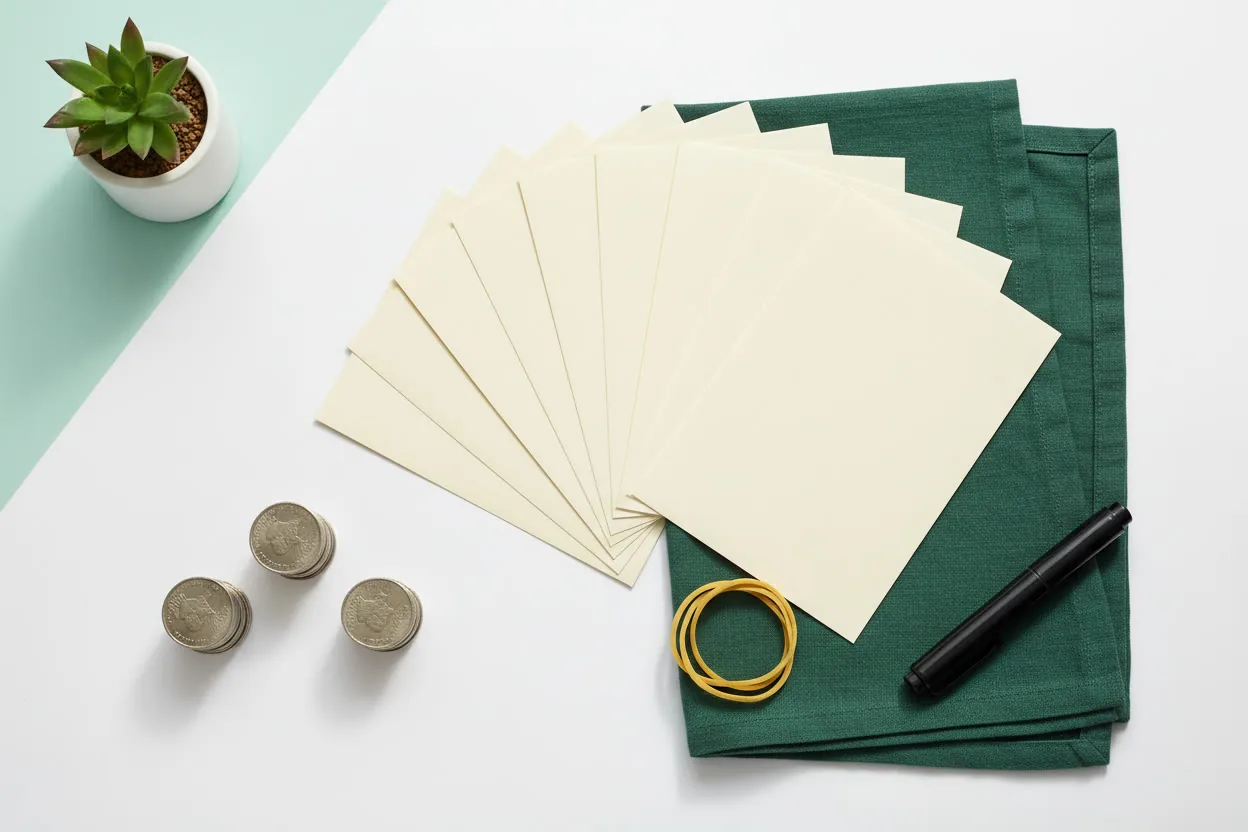
The 100-envelope challenge is one of the simplest savings games there is: 100 numbered pockets, one for each number from 1 to 100, and when they’re all full you’ve saved exactly $5,050. But before you start, the internet will happily sell you a drawer’s worth of “essentials” you don’t need.
Short answer: you need 100 numbered pockets, cash, and a tracker. That’s the whole list. Everything else on this page is a nice-to-have that makes finishing easier, not a requirement. Here’s the honest supplies checklist, what each thing does, and what you can safely skip.
The three things you genuinely need
Strip away the marketing and the challenge runs on exactly three items.
1. 100 numbered pockets or envelopes. This is the heart of the system. You need somewhere to physically hold cash in 100 slots numbered 1 through 100. That can be a zippered binder with pre-numbered pockets, a stack of small paper envelopes you number yourself, or even a set of labeled coin bags. The container doesn’t matter to the math; what matters is that each pocket has a number so you know how much goes in it.
2. Cash. The 100-envelope challenge is a cash challenge by design, because handing over physical bills makes saving feel real in a way a bank transfer never does. You draw a number, count out that many dollars, and seal them away. If you’d rather go cashless, you can run the exact same numbers as transfers into a savings account and just cross the number off a tracker, but you lose the tactile part that makes the challenge stick for most people.
3. A tracker. With 100 numbers in play, you will lose track of which ones you’ve done without something to mark. A tracker is just a grid of the numbers 1 to 100 that you cross off as you fill each pocket. Many binders include one printed on the cover or a first page. A free printable or even a hand-drawn grid does the same job.
That’s it. If you have those three things, you can start the challenge tonight.
The upgrade that most people actually want: a binder
Technically optional, but it’s the single item that turns “I’ll start someday” into “I started.” A pre-made 100-envelope binder bundles the numbered pockets and the tracker into one book, so there’s nothing to set up. You open it and begin on pocket one.
Here’s why the binder earns its $9-to-$16 price for a lot of savers:
- It ships pre-numbered. No sitting down to write 1 through 100 on a hundred separate envelopes, which is exactly the kind of chore that kills a challenge before it starts.
- It keeps everything together. Clear pockets under one cover, so cash can’t scatter across a drawer or fall behind the couch.
- It survives real life. A binder gets tossed in a bag or shoved in a nightstand and holds up. Paper envelopes don’t.
- It looks like something you’ll keep going. Sounds shallow, but a tidy binder you enjoy opening beats a rubber-banded stack you avoid.
Two solid, widely available options at this price point are the Antner A6 budget binder and the Sooez 100-envelope challenge binder. The A6 Antner is compact enough to live in a bag, comes with 12 zippered pockets and 20 labels rather than 100 numbered slots, so you track the numbers on a separate grid, and it doubles as a general budget binder after the challenge; the Sooez is purpose-built for the 100-envelope game with 100 pre-numbered pockets and a laminated tracker ready to go. Either removes the setup friction that trips up beginners. You can compare both through the buttons at the end of this guide and pick the one that fits how you like to save.
The nice-to-haves (helpful, not essential)
Beyond the core kit, a few small extras make the challenge smoother. None are required, so add them only if they solve a problem you actually have.
Labels or a label maker. If your binder didn’t come pre-numbered, or you’re DIYing, clear number labels beat handwriting for legibility. A sheet of printable labels costs a dollar or two.
A pen that shows up on the tracker. Petty, but a bold pen that crosses numbers off cleanly makes the progress feel more satisfying. Use one you like.
A small pouch for “found” money. Some savers keep a separate zip pouch for spare cash, rebates, or rounding-up change, then use it to fill a pocket or two on tight weeks. It keeps the challenge moving when your regular budget is stretched.
A rubber band or clip. For DIY paper-envelope setups, one band around the whole stack stops the spill-everywhere problem. Cheapest fix on this list.
What you can safely skip
Just as useful as the buy list is the don’t-buy list. These get pushed as essentials and mostly aren’t.
- A fireproof cash box for the whole $5,050. You should never let the balance climb that high at home in the first place (more on that below), so you don’t need a safe sized for it.
- Expensive decorative envelope sets. Pretty is fine, but a $30 designer set saves exactly the same $5,050 as a $9 binder. Spend the difference by, well, not spending it.
- An app subscription to “manage” the challenge. A free tracker grid does everything a paid app does here. This challenge is deliberately low-tech.
- Multiple binders “to be safe.” One is plenty. Buying a backup is the first sign you’re shopping instead of saving.
A quick word on keeping the cash safe
The one supply nobody sells you is a habit: move the money to the bank. A binder is great for the daily draw-and-stuff ritual, but a fat stack of bills sitting at home for months is a theft and fire risk (CFPB), and homeowner or renter insurance typically reimburses only a few hundred dollars of lost cash (New York DFS). So treat the binder as a staging area, not a vault.
The simple routine: keep filling pockets for motivation, then every week or two, empty the filled ones into a savings account and mark them on your tracker as “banked.” You keep the satisfying physical habit and the visible progress, without ever having thousands of dollars unprotected in a drawer. A high-yield savings account also earns a little interest while the money waits, which loose cash never will.
Put your supplies to work with a plan
Supplies are the easy part. What keeps the challenge alive is fitting the draws to your real budget so you’re not scrambling to find $97 on a bad week. Before you start, it helps to know where the money is coming from each week and where it’s going when you bank it.
That’s exactly what a simple budget does, and our free budget guide can help your 100-envelope cash land somewhere on purpose. You can grab it on our homepage.
Your 60-second shopping list
To recap, here’s the entire thing on one line: 100 numbered pockets (a binder or envelopes), cash, and a tracker are required; a label sheet, a good pen, and a small pouch are optional; and a safe and app subscription are skippable. Total realistic startup cost: $0 to $16.
If you want the zero-setup route, a ready-made A6 binder from Antner or a purpose-built Sooez 100-envelope binder gets you filling pocket one tonight, with the pockets already done for you. Compare both using the buttons below, then pick the one you’ll actually keep open on the counter.
Once you’ve got your kit, pair it with a budget so every draw has a source and every banked pocket has a home. Start with our free budget guide, and if you want the full walkthrough of how the challenge works, read our guide to the 100 envelope challenge.
Frequently Asked Questions
- What supplies do I need for the 100 envelope challenge?
- At the bare minimum you need 100 numbered pockets or envelopes and a way to track which numbers you've filled. Everything else is optional. A pre-numbered binder rolls the numbered pockets and tracker into one book for around $9 to $16, or you can DIY with paper envelopes and a printable tracker for almost nothing. The cash itself and a safe place to move it are the only non-negotiables beyond that.
- How much does it cost to start the 100 envelope challenge?
- The supplies cost between roughly $0 and $16. DIY paper envelopes plus a free printed tracker cost only what paper and a marker cost you. A ready-made A6 binder with pre-numbered pockets, a tracker, and labels typically runs $9 to $16. That's the entire startup cost, the money you save inside is separate and comes from your own budget over the weeks you run the challenge.
- Do I need a special binder, or will envelopes work?
- Envelopes work fine, a binder just removes friction. Loose paper envelopes are cheapest but you number all 100 yourself and they tear, scatter, and get lost in a drawer. A purpose-built binder keeps every pocket under one cover, ships pre-numbered, and survives being tossed in a bag. Neither changes the $5,050 math. Choose based on whether saving a few dollars or actually finishing matters more to you.
- Is it safe to keep the cash at home while I do the challenge?
- For short stretches, yes; for months, no. A binder protects bills better than loose envelopes, but a growing pile of cash at home is still a theft and fire risk, and home insurance often caps cash reimbursement at a few hundred dollars. Keep the draw ritual for motivation, then sweep the cash into a savings account every week or two so only a small amount sits at home at once.
Sources & references
Before you go
The Already-Done Budget: Pre-Filled Starting Numbers for a Real Household Budget
A budget that starts filled in: 13 categories with realistic starting percentages from the 50/30/20 rule, pre-computed dollar amounts by income, and a worksheet to swap in your real numbers.
Free guide
The Already-Done Budget: Pre-Filled Starting Numbers for a Real Household Budget
A budget that starts filled in: 13 categories with realistic starting percentages from the 50/30/20 rule, pre-computed dollar amounts by income, and a worksheet to swap in your real numbers.