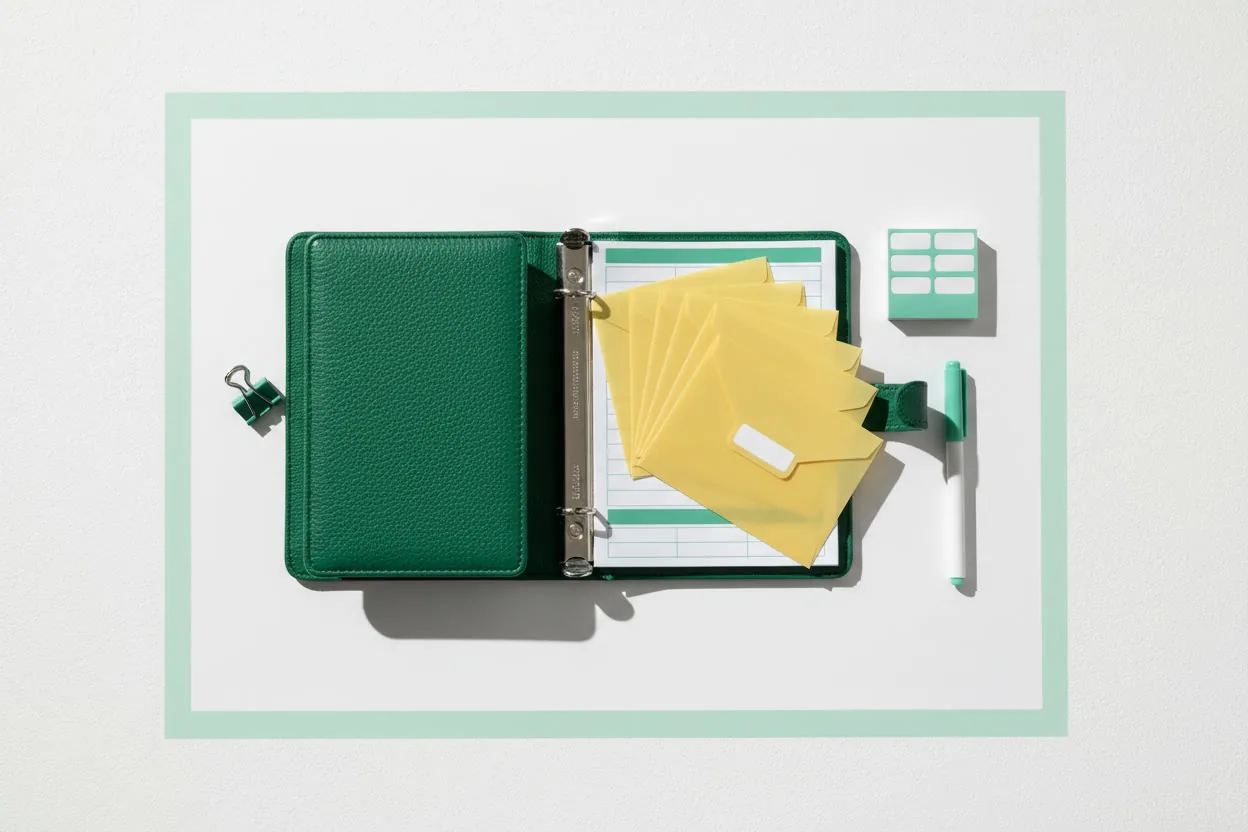
Is tap-to-pay quietly draining your account? A few taps a day barely register until the statement lands, which is part of why the old-school cash envelope system keeps coming back into style. Kits like this one can work as the physical half of a “hybrid” system: a handful of leak-prone categories held in cash while the rest of the budget runs through an app. That’s one way to mix the two, not a settled rule for how anyone has to budget, so take it as one lens rather than a verdict. This review is about one of those physical-side tools, the Sooez Cash Envelope Kit, and whether it earns its small price or just adds a purchase to a plan that’s supposed to save you money. Cons and all, here’s the honest ledger, and a future post on this site will dig into hybrid cash-and-app systems in more detail.
The short version
If you like the idea of cash envelopes but know that fiddly setup is what makes you quit, the Sooez Cash Envelope Kit (around $12) is an easy yes. You get a snap-shut binder, a set of clear zippered pockets with labels, expense sheets, and stickers, so the whole system lives in one book you can carry. It does nothing free paper envelopes can’t, but it removes the friction that kills good intentions in week one. It’s a budgeting tool, not a money maker, and the amount you save depends entirely on your own spending, so your results will vary.
Who it’s for: anyone who wants the cash envelope system to feel organized and portable, who tends to overspend variable categories like groceries and fun money, and who has learned the hard way that a messy pile of paper envelopes gets abandoned by February.
Who should skip it: anyone on a truly bare budget where even $12 is better off inside the grocery envelope itself, and anyone who already tracks well with an app and never overshoots. In those cases, dollar-store envelopes and a marker do the identical job for pennies.
What it actually is (price, format, what’s inside)
Let’s be precise about what you’re buying, because the marketing photos make these kits look fancier than they are. The Sooez Cash Envelope Kit is a compact A6 snap-shut binder, roughly the size of a small planner, built around a ring of clear plastic pockets. A typical kit includes:
- The binder itself: a PU leather cover on a six-ring mechanism that snaps shut with a magnetic fastener, so cash and cards stay put when it’s tossed in a bag.
- Clear cash pockets: 8 zippered pockets that snap into the rings, one per spending category.
- Budget and expense sheets: 24 printed inserts for logging what goes in and out of each category.
- Label stickers: 39 pre-printed category labels across 6 sticker sheets so you can name each pocket.
Price is normally about $10 to $16 depending on the color and the current sale. That’s the whole product. There’s no subscription, no app, no upsell after checkout; it’s a physical binder that arrives and does one job. Refunds run through the standard retailer return window rather than any special guarantee, so if it shows up flimsy, send it back.
Feature by feature: what’s useful and what’s just nice
The snap-shut binder
This is the part that actually matters, and it’s the reason to pick a kit over loose envelopes. The snap closure means your grocery cash doesn’t spill across the couch, and the compact size means the binder comes with you to the store instead of sitting in a drawer where it can’t stop an impulse buy. Portability is the quiet feature that makes the system work, because cash you can’t reach at the register can’t enforce a limit.
The clear pockets
The clear pockets are genuinely handy: you can see roughly how much is left in “groceries” at a glance without opening anything. They’re sized for bills and a few cards, not a fat wad, which is a design choice that mostly helps (it discourages hoarding a fortune in a book at home). The pockets are soft PVC, though, so this is a tool for weekly spending cash, not a vault.
The tracker sheets and labels
The expense sheets are useful for the first month or two while you’re calibrating your category amounts, and then most people stop logging every line and just work the pockets. That’s fine. The labels are the small touch that makes the system feel real: naming a pocket “fun money” and watching it empty is a surprisingly effective nudge. None of this is revolutionary, but it removes the twenty minutes of setup that otherwise never happens.
The honest cons
No product is all upside, and a review that pretends otherwise isn’t worth reading. Here’s where the Sooez kit falls short:
- The pockets are small. A month of grocery cash for a big family makes for a tight pocket. If you run large weekly amounts, the slim A6 size can feel cramped.
- It’s a budget-priced kit. The pockets are soft PVC, so don’t overstuff them, and don’t expect it to survive being sat on.
- It still leaves cash in your home. A binder guards money better than loose envelopes, but a stack of bills at home is a theft and fire risk (CFPB), and home insurance usually caps cash reimbursement at a few hundred dollars (New York DFS). Keep only the current week or two in it.
- It’s single-purpose spending cash. This is a cash envelope binder, not a full financial system. Your bills, savings, and debt payoff still live elsewhere.
How it compares to the free and digital options
The real competition isn’t another binder; it’s a stack of paper envelopes and the budgeting app already on your phone. Here’s the straight comparison.
| Option | Cost | Best at | The catch |
|---|---|---|---|
| Sooez Cash Envelope Kit | ~$10-16 | Portable, durable, zero-setup cash system | Small pockets, light build, cash still at home |
| DIY paper envelopes | A few dollars | Cheapest possible way to try the method | Tear, scatter, no cover, easy to abandon |
| Budgeting app | Free to ~$15/mo (YNAB) | Tracking bills and seeing the whole picture | Tracks after you spend; a soft limit is easy to ignore |
The pattern holds no matter which you pick: the kit buys convenience and durability, paper envelopes buy nothing but do the same core job, and an app tracks money without physically stopping it. Plenty of people land on a combination, running a couple of leaky categories in the binder and everything else in an app. If you want the full method before you buy anything, our cash envelope system guide walks through choosing categories and setting amounts, and cash stuffing for beginners covers the weekly routine.
Pros and cons at a glance
What we liked
- Around $12, so it barely dents what you’re trying to save
- Everything snaps into one portable book, so the system actually leaves the house
- Clear pockets show your remaining balance at a glance
- Pre-printed labels and sheets remove the setup that usually never happens
- Reusable for years; reset the labels and it starts a new season
What we didn’t like
- Pockets are small for large weekly amounts
- Soft PVC pockets; treat them gently
- Cash-at-home risk the binder can’t solve on its own
- Covers spending only, not your whole budget
The verdict
For about the price of one takeout lunch, the Sooez Cash Envelope Kit turns “I should try cash envelopes” into a system you’ll actually keep. It doesn’t do anything paper envelopes can’t, and it won’t fix a budget that hasn’t been written yet. What it does is remove the friction, the setup, the mess, the “where did my envelope go,” that quietly ends most attempts. If you tend to overspend a few variable categories and you know a tidy, portable tool helps you stick with a habit, it’s a genuinely good buy and earns its 9. If even $12 is better off inside your grocery envelope this week, use dollar-store envelopes and feel great about it; the method is what saves the money, not the binder.
If you decide the kit is for you, the offer button is below. Before you fill a single pocket, though, get your plan on one page. Our free budget guide can help, so your categories and amounts are decided before the cash goes in. Grab the free budget guide, then set up your binder. More ways to get your everyday spending under control live in our budgeting basics library.
Frequently Asked Questions
- What is a cash envelope binder kit?
- It's an all-in-one version of the cash envelope system: a snap-shut binder holding clear zippered pockets, plus label stickers and expense-tracking sheets, so each spending category (groceries, gas, fun money) gets its own pocket of cash. Instead of a drawer full of paper envelopes, the whole system lives in one book you can carry. The kit doesn't do anything paper envelopes can't; it just makes the setup faster and harder to lose.
- How much does a cash envelope binder cost?
- Most cash envelope binder kits run about $10 to $16, and the Sooez Cash Envelope Kit sits near the lower end. Prices drift with sales, so check the current number at checkout. Plain paper envelopes cost almost nothing, so you're paying for durability, the label sheets, and the fact that everything closes up in one place. For a tool you'll open every week for years, most people find the small cost pays for itself in convenience.
- Is a cash envelope binder better than a budgeting app?
- They solve different problems. An app tracks money after you spend it; a cash binder stops the spending when the pocket is empty. For categories where you tend to overshoot (groceries, eating out, impulse buys), the physical limit of cash usually works better than a number on a screen you can ignore. Many people use both: the binder for a few problem categories and an app for the bills. It's not either-or.
- Which categories work best with a cash envelope binder?
- Start with the variable, easy-to-overspend categories: groceries, dining out, fun money, personal care, and kids' activities. Leave fixed bills like rent and utilities on autopay, since there's no willpower involved in a payment that's already scheduled. Cash shines exactly where a soft limit fails, so put the binder to work on the two or three categories that always seem to leak.
Sources & references
Before you go
The Already-Done Budget: Pre-Filled Starting Numbers for a Real Household Budget
A budget that starts filled in: 13 categories with realistic starting percentages from the 50/30/20 rule, pre-computed dollar amounts by income, and a worksheet to swap in your real numbers.
Free guide
The Already-Done Budget: Pre-Filled Starting Numbers for a Real Household Budget
A budget that starts filled in: 13 categories with realistic starting percentages from the 50/30/20 rule, pre-computed dollar amounts by income, and a worksheet to swap in your real numbers.