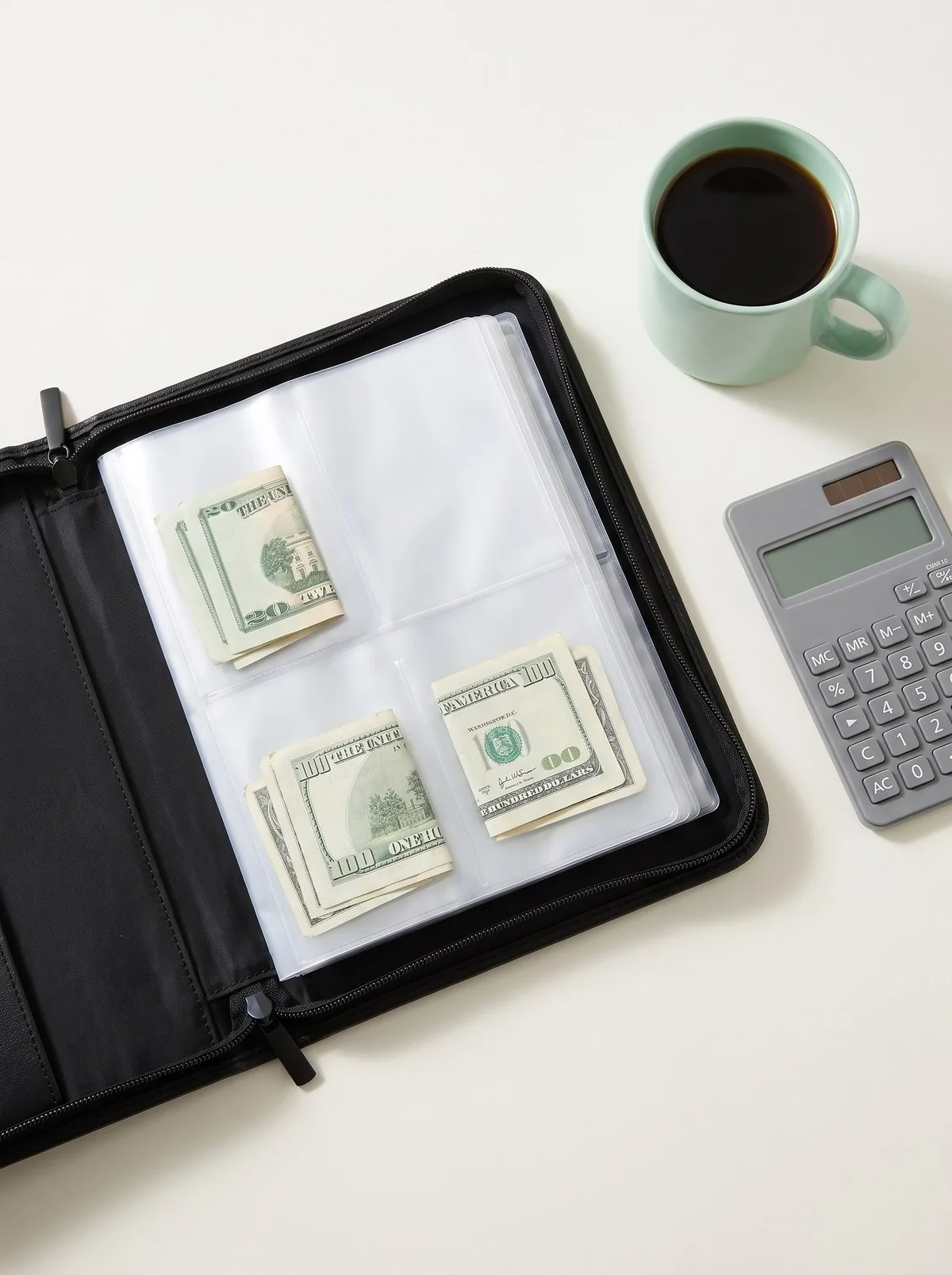
Open TikTok or Pinterest and you’ll find plenty of videos of people slotting crisp bills into labeled pockets, whispering their grocery budget like an ASMR track. It’s called cash stuffing, and it went viral for a very old-fashioned reason: it works. It’s your grandmother’s envelope budgeting with a satisfying new aesthetic, and you can start this weekend with inexpensive supplies. Here’s how.
The short answer: Cash stuffing means dividing your spending money into labeled envelopes or binder pockets, one per flexible category (groceries, gas, fun money). You withdraw that cash after payday, stuff each envelope with its budgeted amount, and then spend only what’s in the envelope. When it’s empty, that category is closed until next month. The physical limit does the discipline for you, so overspending becomes almost impossible.
If you’ve read our full guide to the cash envelope system, this is the trend-forward, beginner-friendly version of the same idea. Same method, newer name, and a binder instead of a shoebox. Let’s set yours up.
Step 1: Understand what cash stuffing does (and doesn’t) do
Cash stuffing is a spending brake, not a money machine. It won’t earn you a dollar, and it can’t fix a budget where the bills are genuinely bigger than the income. What it does, extremely well, is stop the quiet overspending that happens when every purchase is a frictionless tap.
There’s real behavior behind the trend. Researchers who study payment methods have found in lab studies that people tend to spend more freely with credit cards than with cash (Raghubir & Srivastava), and a leading explanation is that cards dull the “pain of paying” that handing over physical bills creates (Banker et al.). Cash stuffing weaponizes that feeling on purpose. When your grocery envelope has $90 left and it’s the 22nd, you feel it, and you make the cheaper dinner. That feeling is the entire product.
So the honest promise is this: if your problem is overspending in flexible categories, cash stuffing is one of the most effective, lowest-tech fixes there is. If your problem is that income is too tight for the essentials, envelopes won’t create money that isn’t there, and no budgeting method can. Know which problem you’re solving.
Step 2: Pick your envelope categories (keep it to a handful)
Cash stuffing only works on variable spending, the categories that flex and tempt. Leave your fixed bills alone. Rent, insurance, utilities, and minimum debt payments don’t change month to month, so they don’t need an envelope. Keep them on autopay from checking.
For everything that flexes, pick four to six envelopes to start:
- Groceries
- Eating out and coffee
- Gas and transportation
- Personal care (haircuts, drugstore runs)
- Entertainment and fun money
- Kids’ extras (if that applies)
Resist the urge to make fifteen envelopes on day one. A wall of tiny categories is how beginners burn out by week two. Start simple, and split a category later only if it keeps blowing up.
Step 3: Set the amount for each envelope
Now decide how much cash goes into each one. If you already have a monthly budget, these numbers come straight from your variable-spending lines. If you don’t have a budget yet, this is the perfect moment to build one, and our step-by-step guide to making a budget for beginners walks you through it in an evening.
Base each envelope on what you actually spent last month, not a fantasy. Pull two months of statements, average each category, and round to a workable number. If groceries really run $480, stuff $480, not the $350 you wish it were. You can trim it $20 at a time as you find savings. A realistic envelope you keep beats a heroic one you abandon.
Here’s a sample setup for one household:
| Envelope | Monthly cash | Withdraw per paycheck (paid twice) |
|---|---|---|
| Groceries | $480 | $240 |
| Eating out | $120 | $60 |
| Gas | $160 | $80 |
| Personal care | $60 | $30 |
| Fun money | $80 | $40 |
| Total | $900 | $450 |
That’s $900 a month of spending you now control physically instead of hoping to.
Step 4: Get your cash and stuff the envelopes
On payday, withdraw the total in bills you can actually split. Ask the bank or ATM for smaller denominations, fives, tens, and twenties, so you can portion each envelope exactly. Then sit down and stuff: count each envelope’s amount and slot it in.
Two beginner tips that save headaches. First, if you’re paid twice a month, stuff half the monthly amount each payday rather than pulling a giant lump on the first. Your cash at home stays lower and your budget stays smoother. Second, keep the little bit of “change” that builds up over the month; sweep it into savings or your next stuffing session instead of letting it evaporate.
This is where a real binder beats a stack of paper envelopes. Loose envelopes tear, scatter, and get raided. A zippered cash-stuffing binder keeps every category in one place, holds the bills flat under a cover, and travels in a bag without spilling your grocery money across the car. The 100 Envelopes Challenge Kit in black is a beginner-friendly pick with pre-labeled envelopes in a waterproof PVC binder and four reusable tracking sheets. The offer button is below if you want a binder built for exactly this, and our roundup of the best 100-envelope challenge binders compares it against the other popular picks. You can absolutely start with dollar-store envelopes today, though; the method matters more than the tool.
Before you stuff a single envelope, it helps to see your whole plan on one page. Our free budget guide can help, so your envelope amounts line up with the rest of your money instead of floating on their own. Grab the free budget guide and fill in your categories first.
Step 5: Spend only from the envelopes
This is the rule the whole system rests on: when you buy groceries, you pay with the grocery envelope. When it’s empty, groceries are done until you refill next month. No dipping into the gas envelope, no “I’ll pay it back,” no card as a backup.
The first month will feel tight around week three, because you’re finally seeing the true edges of your spending. That’s not failure, that’s the data arriving. Push through one full cycle before you judge it. Most people find that by month two, the envelopes have quietly retrained their habits, and the tight week gets less tight.
Step 6: Handle leftovers on purpose
At month’s end, some envelopes will have cash left. Decide in advance what happens to it, because unassigned money wanders off.
Three good options:
- Sweep it to savings. Move leftover cash into your savings account or a sinking fund for a bigger goal. This is where cash stuffing turns into actual saving.
- Roll it forward. Leave it in the envelope so next month’s category starts with a cushion. Great for categories like car maintenance that spike occasionally.
- Reward yourself, on purpose. If the fun-money envelope has a little left, that’s guilt-free spending you earned. That’s a feature.
The one thing you don’t do is let it sit and blur into next month’s spending with no decision. A leftover with a job is a win. A leftover you ignore is just next month’s overspend, prepaid.
A realistic first month
Your first cash-stuffing month is a rough draft, and that’s fine. You’ll misjudge a category or two, run one envelope dry early, and overfund another. Adjust the numbers and run it again. A budget you edit is a budget that’s working.
Keep the cash modest and safe: only your spending money lives in the binder, your real savings stay in the bank, and the binder itself stays somewhere private rather than on the counter. Do that, and cash stuffing gives you the thing that makes every other money goal possible: spending you can actually see and control.
Point your leftovers somewhere that grows. Grab our free budget guide, set up the budget template alongside your envelopes, and send every end-of-month leftover to a savings challenge tracker so your restraint turns into a balance you can watch climb. More systems that make budgeting stick live in our budgeting basics library.
Frequently Asked Questions
- What is cash stuffing?
- Cash stuffing is a budgeting method where you divide your spending money into labeled envelopes or binder pockets, one per category like groceries, gas, and eating out. You spend only the cash in each envelope, and when an envelope is empty, that category is done for the month. It's the same cash-envelope system your grandmother probably used, rebranded by a new generation on TikTok and Pinterest. The physical limit is the whole point: you can't overspend money you can't swipe.
- Does cash stuffing actually help you save money?
- It helps many people spend less, which is where the savings come from. Lab studies of payment behavior have found people tend to spend more freely with credit cards than with cash, and a leading explanation is that handing over bills feels more painful than swiping a card. Cash stuffing puts that friction back on purpose. It won't fix an income that's too low for the bills, and it isn't a way to earn money, but for overspending in flexible categories, the envelope limit is a genuinely effective brake. Your results will vary.
- What categories should I use for cash stuffing?
- Only the variable categories, the ones that flex and tempt you: groceries, dining out, gas, entertainment, personal care, kids' extras, and a small 'fun money' envelope. Leave fixed bills like rent, insurance, and utilities on autopay from your checking account, since they don't change and don't need the envelope brake. Most beginners do well with four to six envelopes. Too many and you'll be shuffling bills all month.
- Isn't it risky to keep cash at home?
- Only your monthly spending cash lives in the binder, not your savings, so we're talking tens or low hundreds of dollars, not thousands. Keep it in a zippered binder somewhere private, not on the kitchen counter, and don't carry every envelope with you at once. Keep true savings and sinking funds in a bank account. The binder is a spending tool, not a vault.
Sources & references
Before you go
The Already-Done Budget: Pre-Filled Starting Numbers for a Real Household Budget
A budget that starts filled in: 13 categories with realistic starting percentages from the 50/30/20 rule, pre-computed dollar amounts by income, and a worksheet to swap in your real numbers.
Free guide
The Already-Done Budget: Pre-Filled Starting Numbers for a Real Household Budget
A budget that starts filled in: 13 categories with realistic starting percentages from the 50/30/20 rule, pre-computed dollar amounts by income, and a worksheet to swap in your real numbers.