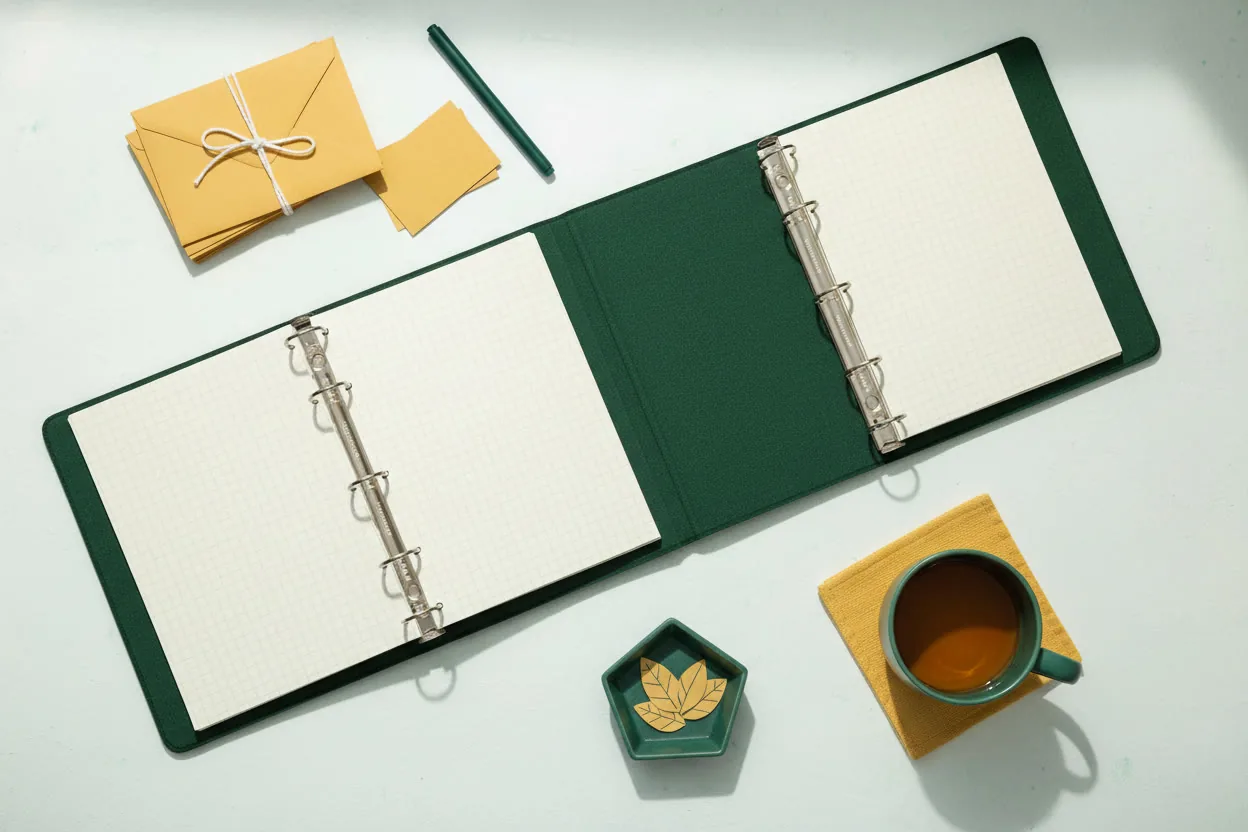
You’ve settled on a budget binder for your cash-envelope system, and now there’s one spec left to decide: A6 or A5. It sounds like a tiny detail, but size is the thing most likely to make a binder feel perfect or annoying, because it decides whether the binder travels with you and whether your cash actually fits. (Still deciding between a standalone binder and a boxed starter set? Our Sooez vs Cash Envelope Kit head-to-head covers that fork first.) Here’s the honest comparison so you pick the right size the first time.
Short answer: get an A6 binder (like the Antner A6) if portability matters most and your weekly cash amounts are modest; get an A5 if you run larger household amounts or want more room to write and track. Most people are happiest with A6, but the wrong size can make you abandon an otherwise good habit.
What the numbers actually mean
A-series paper sizes halve each time the number goes up, so A5 is exactly twice the area of A6 (University of Cambridge).
- A6 is about 4.1 by 5.8 inches (105 by 148 mm), roughly the size of a postcard.
- A5 is about 5.8 by 8.3 inches (148 by 210 mm), roughly the size of a small hardcover book or half a sheet of printer paper.
That’s the whole difference for the inserts; the binder cover adds a little around them, and the Antner A6 binder measures about 7.5 by 5.2 inches. Typically the same six-ring format, same clear zipper pockets, same labels and inserts, just scaled. Everything below flows from that one fact.
The side-by-side
| A6 budget binder | A5 budget binder | |
|---|---|---|
| Insert size | ~4.1 x 5.8 in, postcard-sized | ~5.8 x 8.3 in, small book |
| Portability | Slips into any purse | Fits a tote or backpack |
| Pocket room | Snug for large bills | Roomy for stacks of cash |
| Writing space | Tight inserts | Comfortable to log by hand |
| Price | Budget-friendly | Budget-friendly |
| Best for | Solo or couple, on the go | Families, home-based budgeting |
Prices drift, so confirm the current number at checkout. And as always, neither size changes the math. A dollar in an A6 pocket and a dollar in an A5 pocket are worth exactly the same. You’re choosing comfort and fit, not correctness.
A6: the portable everyday pick
A6 is the compact champion, and portability is its superpower. A binder that lives in your bag comes with you to the store, and cash you can’t reach at the register can’t fund an impulse buy. The A6 disappears into a purse, feels discreet, and is a common size for everyday cash binders.
Where it shines:
- Truly portable. It goes everywhere, which is what makes the habit stick.
- Discreet and compact. Small and unassuming.
- Plenty for modest amounts. For solo and couple budgets, the pockets hold a week of category cash fine.
The trade-offs:
- Snug pockets. Large weekly amounts or high challenge draws make for a tight fold of bills.
- Tight to write in. The small inserts suit checkmarks more than detailed logging.
If A6 is your pick, the Antner A6 Zipper Budget Binder is the versatile everyday option we review in full, with 12 A6 zipper envelopes and 20 self-adhesive labels in the box, and its current listing is linked through the button below.
A5: the roomy home-base pick
A5 trades pocketability for space, and for the right person that’s a great deal. It’s also the size of some numbered challenge binders, like the Sooez 100 envelope binder. The larger pockets swallow a big grocery week without cramming, and the wider inserts give you room to log several categories by hand, which suits anyone who likes to see the whole budget at a glance on a desk.
Where it shines:
- Roomy pockets. Larger household amounts sit comfortably, no tight folds.
- Easy to write in. Wide inserts make hand-tracking pleasant.
- Great as a home base. If your binder mostly lives on a desk, size is a plus, not a burden.
The trade-offs:
- Less portable. It’s more tote-and-desk than throw-in-a-purse.
- Bigger refills. Refill inserts and pockets have to be A5-sized too.
Pick this if
- Pick A6 if you want the binder to travel, you budget solo or as a couple, and your weekly cash amounts are modest. It’s the everyday default for a reason.
- Pick A5 if you run a larger family budget, you prefer writing your tracking by hand, or the binder mostly stays home on a desk.
- Still torn? Default to A6. A binder too bulky to carry is an easy regret, because a binder that stays home can’t stop spending at the register. You can always add a second, larger binder later if you outgrow the pockets.
The binder is the easy part
Whichever size you choose, the binder is a tool, not the plan. What fills those pockets is a budget that tells you where the cash comes from and where it goes when you bank it. Once you’ve picked a size, the extras you buy alongside it matter too, and our guide to budget binder accessories worth the money covers which refills and add-ons earn their place and which to skip.
Our free budget guide can help your binder have a plan behind it from day one. Grab it on our homepage, then check the current A6 listing with the button below and get the full method in our guide to the cash envelope system. More game-like money plans live in our savings challenges library.
Frequently Asked Questions
- What's the difference between an A6 and an A5 budget binder?
- The difference is size. An A6 binder holds inserts about 4.1 by 5.8 inches, roughly postcard size, so it slips into a purse and travels easily. An A5 binder holds inserts about 5.8 by 8.3 inches, closer to a small hardcover book, with pockets and inserts twice the area. A6 wins on portability and discretion; A5 wins on writing room and pocket capacity. Both commonly use a six-ring cash-envelope format and hold the same categories.
- Which size is better for a family budget?
- For a bigger household running larger weekly amounts, the A5 pockets hold cash more comfortably and the wider inserts leave room to track several categories at once. A single person or couple with modest weekly cash usually prefers the A6, because the smaller pockets are plenty and the binder actually leaves the house. Match the size to how much cash flows through each pocket, not to how organized you hope to feel.
- Is A6 or A5 better for the 100 envelope challenge?
- Both sizes work. A6 is compact and easy to carry, while many numbered challenge binders, including the Sooez 100 envelope binder, are built in A5. An A5 gives you roomier numbered pockets if high draws in tight A6 pockets bother you, but it's bulkier. Pick A6 if carrying it matters most, and A5 if pocket room does.
- Do A6 and A5 binders cost about the same?
- They're close. Both sizes are widely sold at budget-friendly prices, and prices drift with retailer and sale, so check the current listing. Refill pockets and inserts must match your binder size, so factor a small ongoing cost for whichever size you choose if you plan to expand it.
Sources & references
Before you go
The Already-Done Budget: Pre-Filled Starting Numbers for a Real Household Budget
A budget that starts filled in: 13 categories with realistic starting percentages from the 50/30/20 rule, pre-computed dollar amounts by income, and a worksheet to swap in your real numbers.
Free guide
The Already-Done Budget: Pre-Filled Starting Numbers for a Real Household Budget
A budget that starts filled in: 13 categories with realistic starting percentages from the 50/30/20 rule, pre-computed dollar amounts by income, and a worksheet to swap in your real numbers.