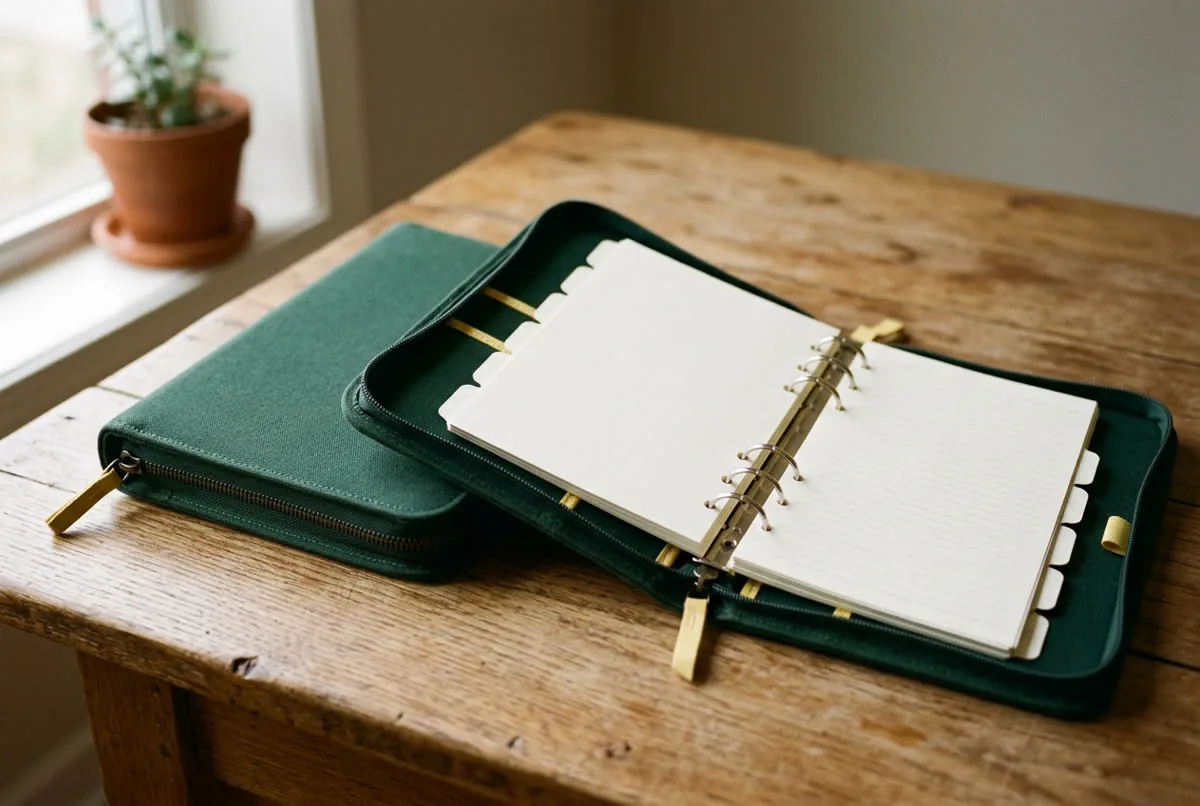
If you’ve decided a budget binder beats loose paper envelopes for your cash-envelope system or 100-envelope challenge, you’ve probably run into the same two names over and over: Antner and Sooez. They’re both affordable, both PU leather, and both do the core job. So which one should you actually buy?
Short answer: get the Sooez if your main goal is the 100-envelope challenge and you want a purpose-built savings-challenge binder; get the Antner A6 if you want a compact, versatile binder you’ll keep using as a general budget system long after the challenge ends. Here’s the full head-to-head so you can match the right one to how you save.
What these two have in common
Before the differences, it’s worth saying the tie: for most people, either one will do the job well. Both are:
- PU leather binders with clear pockets that hold cash in labeled or numbered slots).
- Budget-friendly, typically in the same $9-to-$16 range depending on retailer and sale.
- Beginner-friendly, they ship ready to use with no envelopes to assemble.
- Portable enough to keep on a counter or slide into a bag.
Neither changes the math of what you’re saving. A dollar in a Sooez pocket and a dollar in an Antner pocket are worth exactly the same. So this comparison is about fit and friction, not about one being “correct.”
Antner A6: the versatile everyday binder
The Antner A6 is built as a compact, general-purpose budget binder. A6 is a small format, about 7.5 by 5.2 inches for this binder, roughly the size of a small notebook, which is the whole point: it disappears into a bag and comes with you.
Where it shines:
- Compact and portable. The A6 size is genuinely pocketable in a purse or backpack, so your budgeting system travels instead of living in a drawer.
- Versatile beyond one challenge. It works for the 100-envelope challenge, but it’s equally at home as an ongoing cash-envelope budget, sinking-fund holder, or general money binder. When the challenge ends, the binder keeps earning its place.
- Discreet. Small and unassuming, it doesn’t announce that you’re carrying cash.
The trade-offs:
- Fewer pockets. It ships with 12 zippered pockets and 20 labels, not 100 numbered slots, so for the 100-envelope challenge you track the numbers on a separate grid and group the cash by pocket.
- Less challenge-specific setup. It’s a general binder, so it’s not laser-focused on the 100-envelope tracker experience the way a purpose-built one is.
The Antner suits the person who thinks past a single challenge, who wants one small binder that handles the 100-envelope game and becomes their permanent budgeting tool. You can check its current listing through the button at the end.
Sooez: the purpose-built challenge binder
The Sooez binder leans into the savings-challenge use case. It’s designed around the numbered-pocket game, so it tends to come set up for exactly that experience.
Where it shines:
- Challenge-ready out of the box. Built around the savings-challenge format with 100 clear pockets pre-numbered 1 to 100 and a double-sided laminated tracker, so you open it and start on pocket one with nothing to configure.
- A satisfying, focused experience. If the 100-envelope challenge is your specific goal, a binder made for it feels purpose-fit, the tracker and layout keep you motivated toward the finish.
- Clear, numbered pockets that make the fill-and-track ritual easy to see and enjoy.
The trade-offs:
- More single-purpose. It’s optimized for the challenge, so it’s less of a natural “forever” everyday budget binder than a compact general one, though plenty of people repurpose it after.
- Less pocketable. It’s an A5 binder, a size up from the Antner’s A6, so it’s more counter-and-drawer than throw-in-a-purse.
The Sooez suits the person laser-focused on completing the 100-envelope challenge who wants the whole thing done for them, with numbered pockets and a tracker ready to go. Its listing is linked through the button below as well.
Head-to-head scorecard
Boiling it down into one table so you can scan it in five seconds:
| Factor | Antner A6 | Sooez |
|---|---|---|
| Best for | Long-term, everyday budget binder | The 100-envelope challenge specifically |
| Format | Compact A6 ring binder | Larger A5 binder, challenge-oriented |
| Portability | Fits a bag or purse easily | Bulkier; more counter-and-drawer |
| Pockets | 12 zippered pockets | 100 numbered pockets |
| Setup | Ships ready to use, with 20 labels | Ships ready to use, plus a laminated tracker |
| Price | ~$9–$16 | ~$9–$16 |
| Life after the challenge | Keeps earning its place as a general binder | More single-purpose, though plenty reuse it |
If you read that and one clearly matches your goal, buy that one and don’t overthink it. Both are inexpensive enough that the “wrong” choice is still a perfectly good binder.
How to decide in one question
Ask yourself: is this binder mainly for the 100-envelope challenge, or for my budget in general, forever?
- Mainly the challenge? Go Sooez. The purpose-built layout keeps you motivated to the $5,050 finish line.
- My budget in general, and I want it to travel? Go Antner A6. It handles the challenge now and becomes your everyday money binder after.
Still torn? Default to the Antner A6. Versatility usually wins over the long run, because the challenge ends but budgeting doesn’t, and a small binder you’ll keep using beats a specialized one that goes in a drawer once the pockets are full.
The binder is the easy part
Whichever you pick, remember the binder is a tool, not the plan. What actually fills those pockets is a budget that tells you where the cash comes from each week and where it goes when you bank it. And whatever you save, don’t let thousands of dollars sit in a binder at home, since cash can be stolen, lost, or destroyed (CFPB); sweep the cash into a savings account every week or two and let the tracker show your progress.
Our free budget guide can help your binder have a plan behind it from day one. Grab it on our homepage. Compare both binders using the buttons below, then get the full walkthrough in our guide to the 100 envelope challenge and our roundup of the best 100 envelope challenge binders.
Frequently Asked Questions
- Is the Antner or Sooez binder better for the 100 envelope challenge?
- For the pure 100-envelope challenge, the Sooez is the more purpose-built pick because it's designed around the numbered-pocket savings game with 100 pre-numbered pockets and a tracker ready to go. The Antner A6 is the better all-rounder if you want a compact binder you'll keep using as a general budget system after the challenge ends. Both hold cash in clear pockets; the choice is challenge-specific vs long-term versatility.
- What's the main difference between the Antner and Sooez binders?
- The biggest practical difference is purpose and format. The Antner A6 is a compact, general-purpose budget binder built to travel in a bag and serve many budgeting jobs. The Sooez leans into the savings-challenge use case with 100 numbered pockets and a tracker. Both are affordable binders with clear pockets; you're choosing between a versatile everyday binder and a challenge-focused one.
- How much do the Antner and Sooez binders cost?
- Both sit in the same budget-friendly range, commonly around $9 to $16 depending on the retailer, bundle, and any sale. Prices change often, so check the current listing before buying. At this price point the decision usually comes down to size and purpose rather than cost, since neither is expensive and both save the exact same amount of money inside their pockets.
- Do I even need a binder, or will paper envelopes work?
- Paper envelopes work and cost almost nothing, but a binder removes friction. A binder keeps every pocket under one cover, ships ready to use, and survives being tossed in a bag, which loose envelopes don't. If saving a few dollars matters most, DIY envelopes win. If actually finishing the challenge matters most, a binder's convenience is worth the modest price. Neither changes the underlying savings math.
Sources & references
Before you go
The Already-Done Budget: Pre-Filled Starting Numbers for a Real Household Budget
A budget that starts filled in: 13 categories with realistic starting percentages from the 50/30/20 rule, pre-computed dollar amounts by income, and a worksheet to swap in your real numbers.
Free guide
The Already-Done Budget: Pre-Filled Starting Numbers for a Real Household Budget
A budget that starts filled in: 13 categories with realistic starting percentages from the 50/30/20 rule, pre-computed dollar amounts by income, and a worksheet to swap in your real numbers.