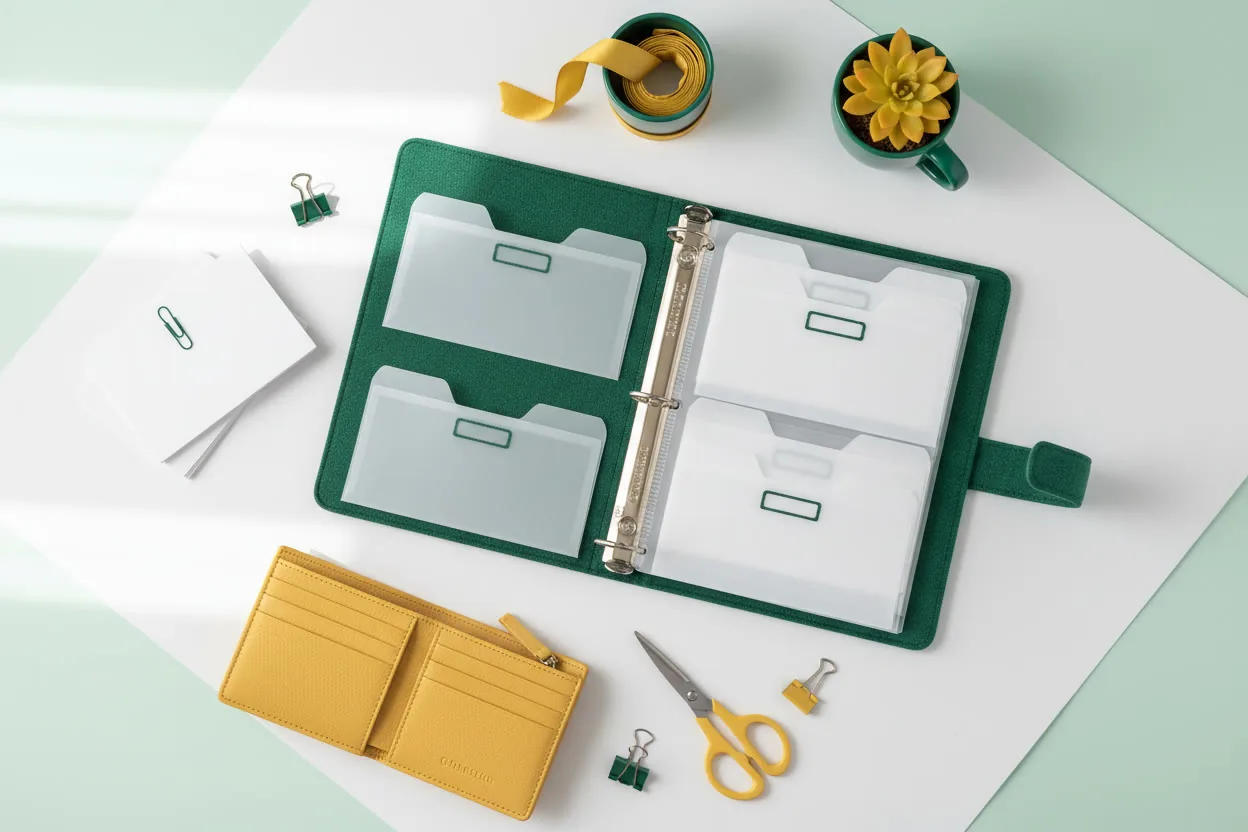
Is tap-to-pay quietly draining your account? A few taps a day barely register until the statement lands, which is part of why old-school cash challenges like the 100 envelope challenge keep coming back into style. Some 2026 budgeting commentary has started framing challenge binders like this one as the cash half of a “hybrid” system: a stack of savings built by hand with physical bills while the rest of the budget runs through an app. That’s an emerging way people are talking about the mix, not a settled rule for how anyone has to save, so take it as one lens rather than a verdict. You have decided to run the 100 envelope challenge, and the Sooez binder keeps showing up as the one everyone buys first. At around $9 it is cheap enough to feel like a no-brainer, but “cheap and popular” is not the same as “right for you.” So here is the honest version: what the binder actually is, where it shines, the couple of things to watch for, and the one person who should skip it and use paper envelopes instead.
Our verdict up front
The Sooez 100 Envelopes Money Saving Challenge Binder is the best first binder for the 100 envelope challenge, mostly because it removes the friction that kills good intentions in week one. It ships with 100 pre-numbered pockets and a reusable laminated tracker, so setup time is effectively zero, and the magnetic-closure cover keeps your cash contained far better than loose envelopes. At around $9 it barely dents what you are saving. The honest catch: it is single-purpose, and it cannot solve the cash-at-home risk on its own.
Who it is for: a first-timer who loves the draw-and-stuff ritual, wants the challenge to feel like a game, and knows that friction (numbering 100 envelopes by hand) is exactly what makes people quit.
Who should skip it: anyone on a truly bare budget where even $9 is better off inside envelope one. In that case a pack of dollar-store envelopes and a marker does the identical job, and you should feel great about it. The binder buys convenience, not results.
How we approached this review
Quick context, because “honest review” is what every affiliate page claims. Smart Cents Club earns a commission if you buy the binder through the link on this page, and that is true of most Sooez binder reviews you will find. What we can offer is simple: we treat the cons as content, not as an inconvenience, and we would rather you use free envelopes than regret a purchase. We judged this binder on one question, the same one we ask of every tool in our savings challenges library: would it actually help someone finish the challenge, or does it just look good in a photo?
What the Sooez binder actually is
The facts, minus the product-listing gloss:
| Detail | What we found |
|---|---|
| Format | A5 binder with 100 pre-numbered clear PVC cash pockets |
| Price | $7.99 on Amazon as of October 2026, one-time; check the current listing |
| Sold by | Sooez, through online retailers including Amazon |
| In the box | The binder, 100 numbered pockets, and one double-sided laminated tracker with 100-envelope, 52-week, and 30-day challenge options |
| Cover | PU leather, with a magnetic closure to keep cash in |
| Returns | The seller’s standard return window (no course-style guarantee) |
In plain terms, it is a small book of clear pockets built for one job: running the 100 envelope challenge without assembling anything yourself. You open it, shuffle your draw order, and start on pocket one. There is no app, no subscription, and nothing to configure.
One thing to confirm before you buy: Sooez makes several binders, including smaller A6 budget binders with 8 zipper pockets. For the 100 envelope challenge you want the 100-pocket model specifically, so read the listing title, not just the brand name.
Where the $5,050 comes from
Since the whole point of the binder is holding this challenge, here is the math that makes it famous. Add every number from 1 to 100. Pair the smallest with the largest: 1 + 100 = 101, 2 + 99 = 101, and so on. There are 50 such pairs, so 50 x 101 = $5,050. That is the ceiling of a fully stuffed binder, full stop. It is a savings total, not earnings, and nobody can promise you will reach it, because that depends entirely on your cash flow and how far you get. Your results will vary. If the full climb feels steep, the half version fills every other pocket and totals $2,525. Our complete walkthrough of how the 100 envelope challenge works covers the rules, the random-draw psychology, and the digital version.
Feature by feature: what earns its keep, what to watch
The 100 pre-numbered pockets
This is the headline feature, and it is the reason to buy over DIY. You are not writing “1” through “100” on a hundred paper envelopes at your kitchen table, which is the exact chore that ends most challenges before they start. The pockets are clear, so you can see your progress fill in, and they are sized for the challenge. The watch-out: high draws mean more bills per pocket, so paying them in larger bills keeps each pocket slim.
The magnetic-closure cover
Loose envelopes scatter, tear at the corners, and leave your cash one curious toddler away from redistribution. The Sooez cover closes with a magnetic clasp around everything, so the whole challenge travels as one contained book. That portability matters more than it sounds: a binder you can toss in a tote makes the gentle two-a-week pace easy to keep, because you can stuff a pocket the moment you skip a coffee. The watch-out: a magnetic flap is not a lock, so do not overstuff it or swing it around by the cover.
The laminated tracker
The laminated tracker turns saving into a game you can see. Marking off a completed number is a small, genuinely motivating hit, and a visible streak is weirdly powerful once you are nine pockets deep. It is erasable, so you can rerun the challenge or switch to its 52-week or 30-day plan. The watch-out: the tracker is a single sheet, so if you love detail, pair it with a fuller worksheet of your own (any blank grid or spreadsheet works).
The A5 size and build
A5 is a standard notebook size. Small enough to be portable, big enough to hold the pockets comfortably. For about $9, it is built for a challenge you run once or twice a year, not as an heirloom. The watch-out: this is a challenge binder, not a full budgeting system. If you want one binder for sinking funds, category envelopes, and everyday cash stuffing, a general zipper binder like the Antner A6 is the better shape, and we compare them directly in Antner vs Sooez.
Pros and cons
What we liked
- Around $9, so it barely dents your savings
- 100 pockets arrive pre-numbered, so setup time is effectively zero
- Notebook-size A5 binder fits in a bag, which makes the gentle two-a-week pace easy to keep
- Includes a reusable laminated tracker, so progress is visible and motivating
- The magnetic-closure cover keeps cash contained far better than loose paper envelopes
- Reusable: finish, empty it into savings, and run the challenge again next year
What we didn’t like
- Single-purpose: it is a challenge binder, not a full budget-and-sinking-fund system
- It is an inexpensive binder, so do not overstuff it
- It still leaves cash in your home, a risk the binder cannot solve on its own
None of these are dealbreakers for what it costs. It does one job, and it does it for about nine dollars.
Sooez binder vs. DIY paper envelopes
We will not pretend the answer is always “buy the binder.” DIY paper envelopes cost almost nothing: a pack of 100 from the dollar store plus a marker, and you are set for a couple of dollars. The catch is the work and the mess. You number 100 envelopes by hand, they tear, they scatter, and the pile has no cover.
| Sooez binder | DIY paper envelopes | |
|---|---|---|
| Cost | ~$9 | A few dollars |
| Setup | Pre-numbered, zero work | Number 100 by hand |
| Durability | Magnetic cover, reusable | Tears and scatters |
| Portability | Fits in a bag | Loose, stays home |
| Savings math | $5,050 full set | $5,050 full set |
The binder does not change the math. A dollar in a Sooez pocket and a dollar in a paper envelope are worth exactly the same. You are paying purely for convenience and for the nudge that a finished-looking tool gives you to actually finish. Our honest rule: if $9 is genuinely better off inside the challenge, use DIY and feel great about it. If you know from experience that friction is what makes you quit in week nine, the binder is one of the cheapest habit tools you will ever buy. For the wider field, see our roundup of the best 100 envelope challenge binders.
So, should you buy it?
Here is the test we would apply. Answer these three:
- Have you quit a savings challenge before because setup felt like a chore? If yes, the pre-numbered pockets are worth $9 on their own.
- Do you want to carry the challenge with you? The A5 size and magnetic cover make the gentle pace stick. A binder in a drawer does not.
- Is $9 genuinely spare? If even that belongs inside envelope one this month, buy the dollar-store envelopes now and the binder next year with money you did not spend.
If you cleared all three, the offer button below goes to the current listing. If you did not, you are not missing a secret. The binder is convenience, and convenience is optional.
Whichever way you go, put your plan on paper first, so your draws, your budget, and your progress live on one printed page. Grab our free budget guide, then decide on the binder. And whatever you save, do not let $5,050 in paper pile up at home: sweep it into an FDIC-insured savings account every week or two (FDIC), and let the tracker show your progress.
Frequently Asked Questions
- Is the Sooez budget binder worth it?
- For most first-timers, yes. At around $9 it ships with 100 pre-numbered pockets and a reusable laminated tracker, so the setup that usually kills a challenge in week one is done for you. It won't do anything a stack of dollar-store envelopes can't do in theory, but it removes the friction that makes people quit, and it keeps your cash under one magnetic-closure cover instead of scattered across a drawer. If even $9 is better off inside the challenge, DIY envelopes are the honest call.
- How many pockets does the Sooez binder have?
- The 100 Envelopes version has 100 numbered pockets, one for each number from 1 to 100, which is exactly what the 100 envelope challenge needs. Sooez also sells smaller A6 budget binders with 8 zipper pockets for general cash stuffing, so check the listing title before you buy to make sure you're getting the 100-pocket challenge model and not a general budget binder.
- Does the Sooez binder really save $5,050?
- The binder holds the challenge; it doesn't create money. The numbers 1 through 100 added together equal exactly $5,050, so a fully stuffed binder contains that amount. That's arithmetic, not a promise. Whether you finish, and how fast, depends on your budget and your own spare cash, so your results will vary. The half version totals $2,525 if the full climb is too steep.
- Is it safe to keep cash in the Sooez binder at home?
- For a week or two at a time, it's fine, and the closed cover protects the cash better than loose paper. But a large pile of bills at home is still a theft and fire risk, and home insurance policies often limit how much lost or stolen cash they will reimburse. Keep the draw ritual, then sweep the cash into a savings account every week or two and let the tracker show your progress.
- Can I return the Sooez binder if I don't like it?
- It's a physical product sold through online retailers, so it falls under the seller's standard return window rather than a course-style money-back guarantee. Check the return policy on the listing before you order, keep the packaging until you've tried it, and if the binding or pockets aren't what you expected, start a return the same way you would for any other item.
Sources & references
Before you go
The Already-Done Budget: Pre-Filled Starting Numbers for a Real Household Budget
A budget that starts filled in: 13 categories with realistic starting percentages from the 50/30/20 rule, pre-computed dollar amounts by income, and a worksheet to swap in your real numbers.
Free guide
The Already-Done Budget: Pre-Filled Starting Numbers for a Real Household Budget
A budget that starts filled in: 13 categories with realistic starting percentages from the 50/30/20 rule, pre-computed dollar amounts by income, and a worksheet to swap in your real numbers.